Author: Gershon Ben Keren
I have worked with healthcare professionals, both in the UK and US, for a number of years, looking at ways to de-escalate angry/aggressive patients and family members etc. In fact, healthcare is probably the industry sector that I’ve spent the most time with, both in the creation and adoption of policy measures, and in training individuals and departments, in threat identification, risk mitigation/management, de-escalation and physical solutions to deal with attacks and assaults etc. For me there is a huge sense of injustice when a person who has dedicated themselves to helping others is violently assaulted by those – and/or their family members – that they are trying to help. This is not a small problem. The Massachusetts Health and Hospital Association estimates that a healthcare worker is verbally or physically assaulted every 36 minutes. Whilst it is easy to underplay verbal assaults, these are often entryway behaviors that can lead to physical violence, and the psychological/emotional toll of being threatened, even when this doesn’t lead to a physical assault, shouldn’t be underestimated.
Under current Massachusetts State Law someone can only be directly arrested if an officer witnesses an assault, and healthcare workers are required to press charges themselves if they want to seek justice legally; this means that if they want to do this they are often bringing charges against those they care for and are seeking to help. However, there is a bill in Massachusetts that seeks to address these issues, along with making assaults on healthcare workers a felony rather than a misdemeanor. Whilst I am in favor of the bill as it both recognizes and highlights the violence that healthcare workers face and includes provisions for paid leave for employees who are assaulted on the job etc., whether it will act as a deterrent to violent behaviors and actions isn’t so clear. It is this relationship that I want to examine i.e., the deterrent effect of punishment.
Harsher sentencing, i.e., longer sentencing, has the potential to reduce violent crime. If you incarcerate persistent violent offenders, you remove them from society, and so they are no longer able to offend against society. For certain populations/groups targeted deterrence can work e.g. in Glasgow, gang members were publicly identified by law-enforcement and informed about how they would be sentenced (importantly they were also presented with legal routes out of crime and violent offending). However, not all violence is the same and it is worth considering whether the majority of those who verbally and physically assault healthcare workers are persistent offenders, or belong to specific groups whose identity involves violence. Both of these aforementioned groups generally engage in premeditated violence i.e., they are individuals who arrive at a location with the goal of becoming violent; this is generally not the case with violence in healthcare settings.
Most – but not all – acts of violence in healthcare settings tend to occur in emergency rooms (casualty – in the UK). These are settings where there are often long wait times, because those requiring the most serious and immediate treatment are seen first. So, whilst a painful but non-life-threatening injury might be a priority to the person who is suffering, resources will be prioritized to the individual who is having a heart attack and potentially minutes away from dying. Healthcare perhaps gives us the best example of the “economic problem” i.e., that human wants are unlimited, but the resources available to satisfy those wants are limited. There will almost never be enough resources to meet the immediate needs of everyone in an emergency room, especially at certain times of the day and week. This is not a failing of the staff, or even the system, it’s just the fact that resources need to be prioritized. Unfortunately, this fact is often not understood in the moment by someone – and/or family members etc. - who feels/believes that their particular need is the priority. Having to wait to be treated is often interpreted as having their “need” not being valued, which is an emotional rather than cognitive slight.
In most cases in such settings and situations when violence occurs it is not rational. Someone reading this article in a calm state probably understands all too well that when resources are limited (and in an emergency room on a Friday night that is a given), those who are in the most urgent need are seen/treated first, and the best person to make such an assessment are those working in the department. However, if you are in pain, and have to wait in an emergency room to be seen, it is all too easy to lose sight of this fact. If you are accompanying a friend or loved one etc., and they are in pain, witnessing this, even when rationally you understand it, can leave you with a sense of helplessness, that makes you uncomfortable. Most instances of violence are spontaneous and occur without planning and any kind of risk assessment. Approximately 23% of emergency department shootings involve a firearm that was taken from a security officer or law enforcement personnel. This doesn’t include the number where a weapon was taken and not discharged. These were individuals who didn’t have a weapon on them but felt the need to both take and use one in order to have their “needs” met. These were not individuals who were considering whether their act would be judged as a misdemeanor or a felony etc.
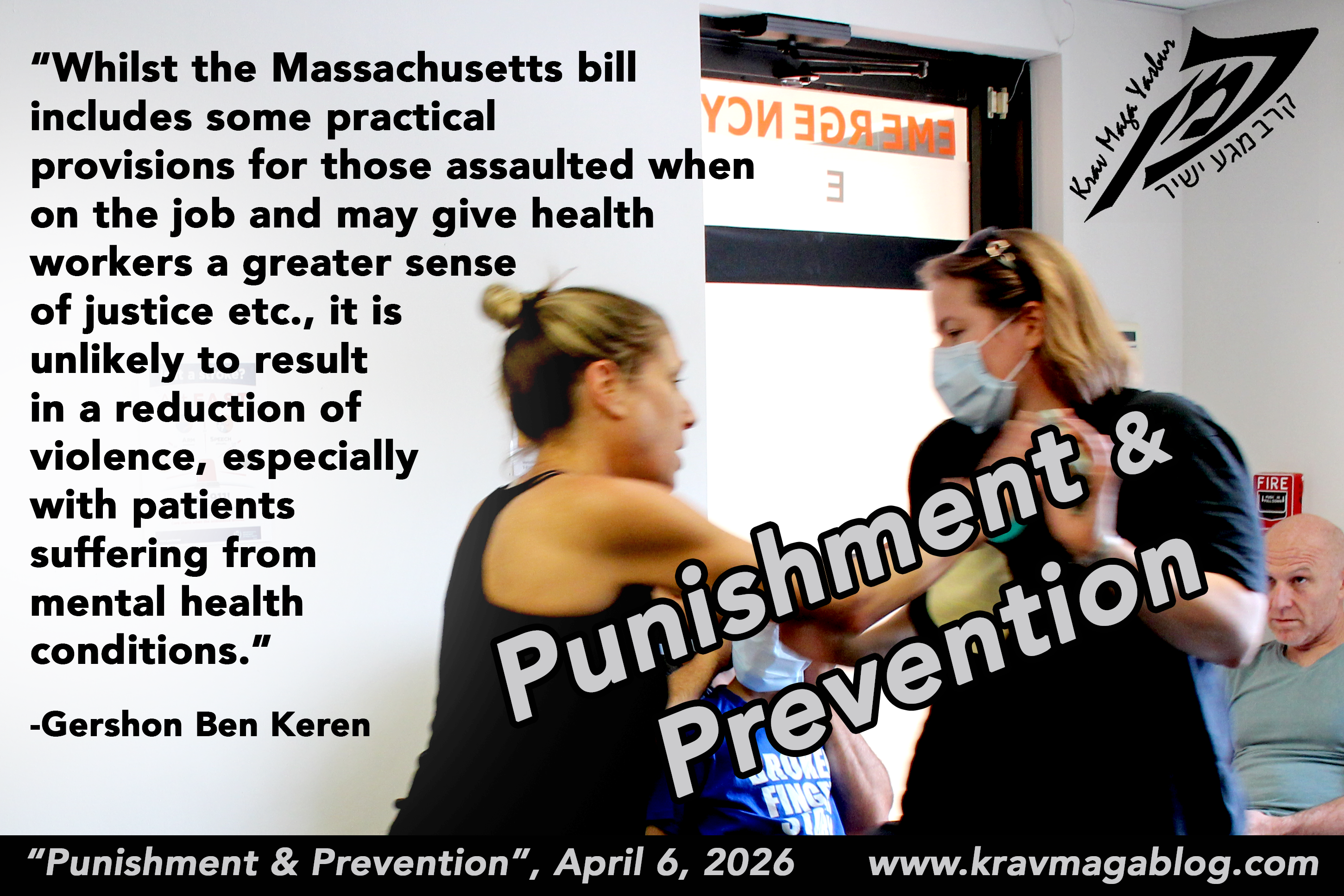
Most research has shown that where punishment is an effective deterrent, it involves the certainty of apprehension and the speed/immediacy of sentencing, and not the harshness of the sentence. This is one of the reasons why the death penalty in the US doesn’t act as an effective deterrent (whether it is a suitable punishment is a different debate/discussion). Whilst the Massachusetts bill includes some practical provisions for those assaulted when on the job and may give health workers a greater sense of justice etc., it is unlikely to result in a reduction of violence, especially with patients suffering from mental health conditions (another discussion regarding the effectiveness of legislation in such settings).