Author: Gershon Ben Keren
A few months ago, I wrote about the I³ Model (pronounced "I-cubed") that social psychologists Paul A. M. van Lange and Eli Finkel created and developed based on research they’d done (this article can be accessed by clicking here). Their model looks at how three factors - Instigation, Impellance, and Inhibition – interact to create aggressive/violent responses that result in what they termed “Momentary Aggression” i.e., aggression that occurred in the moment as a response to a perceived threat or injustice; something that is often referred to as spontaneous violence. In this article I want to look at how the I³ Model can be applied to a variety of real-life interactions, and how these can bring out different facets of the theory model to help better understand how it works and the interplay of the three components necessary to create an aggressive/violent incident/interaction. The examples used are from incidents in Boston and Massachusetts.
In August 2022, in a Boston suburb, a man was assaulted after a verbal altercation over a parking space outside a supermarket. This incident was captured on the supermarket’s surveillance/CCTV footage. The assailant punched the victim in the face, knocking him unconscious. He was arrested on the scene and later claimed he “snapped” after feeling disrespected by the other driver. The trigger that initiated the confrontation was a verbal exchange in which the victim/target of the assault accused the perpetrator of “stealing the space” along with calling him a “selfish idiot.” These insults served as the external trigger which created the necessary conditions to activate an aggressive response. One of the things that always puzzles me about parking space disputes is that even if a person is in the right and someone “stole” a space they were waiting for, believed they were entitled to etc., why leave/park your car in a space where the other person knows your car is? If you’ve annoyed them and made them angry there’s nothing to prevent them “keying” your paint work or slashing your tires, and there’s nothing guaranteeing that this will be captured by CCTV. Without this confrontation (Instigation), the incident would likely not have occurred. Several risk-enhancing factors concerning the incident were identified. The perpetrator had just consumed alcohol, likely amplifying his emotional reactivity/arousal and was already stressed from a dispute at work earlier that day. The temperature that day was also high, possibly creating heat irritability (Impellance). Together, these created a volatile internal state, making him highly susceptible to provocation. To the perpetrator’s knowledge there were no strong external deterrents such as authority figures and/or surveillance he was aware of (capable guardians) i.e., his Inhibition(s) to respond violently were reduced.
The model can also be used to describe/explain certain types/incidents of domestic violence. In October 2020, a 34-year-old man in Worcester, Massachusetts, was arrested after assaulting his partner. The incident began when he saw a text message from a male coworker that had been sent to her phone. After seeing it he punched his partner in the face and then threw her phone against a wall. The police were called by neighbors who heard screaming. The immediate instigating event (the trigger) was the arrival of a text from another man, which the offender perceived as evidence of infidelity. His partner’s response was one of surprise and dismissing it as a joke, which he perceived to be minimization, further provoking/escalating his anger. These two things were the initial Instigation of his violent response. He reported, when interviewed by law-enforcement, feeling humiliated and betrayed, linking the moment to core identity threats ( neighbors stated that he had a history of paranoia and jealousy). These Impellance factors acted as fuel for the initial spark/trigger. Having consumed alcohol, his executive control was reduced and there were no third parties present who could act as a deterrent or disrupt his escalating emotions, i.e., nothing to control/regulate his Inhibition.
The I³ Model can also explain group violence. During the 2023 St. Patrick’s Day celebrations in South Boston - for those unaware, this is a large annual event involving a major parade, dense crowds and the obligatory heavy drinking - multiple fights broke out near bars on West Broadway. One altercation, involving over a dozen individuals, led to serious injuries and arrests. Surveillance footage along with bystander videos (posted on social media) showed escalating verbal altercations and pushing, which then led to punches and bottles being thrown. Later analysis and reports by law enforcement attributed the violence to intoxication, overcrowding, and long-standing rivalries between various local groups. The immediate provocations (Instigation) involved verbal insults exchanged between two men outside a bar, along with accidental contact such as shoulder bumps and/or spilt drinks etc. In crowded public events, instigation often arises from low-level interpersonal frictions, especially when individuals are on edge from environmental stimuli such as noise, intoxication, and crowding etc. Several Impelling factors intensified the likelihood of escalation including the fact that the crowd was composed of young men, often in groups that involved “in-group/out-group” dynamics, which increased the social pressures for dominance and saving face etc. Police presence was low in these areas and social anonymity was high, leading to an increase in social anonymity that led to a reduction in Inhibition.
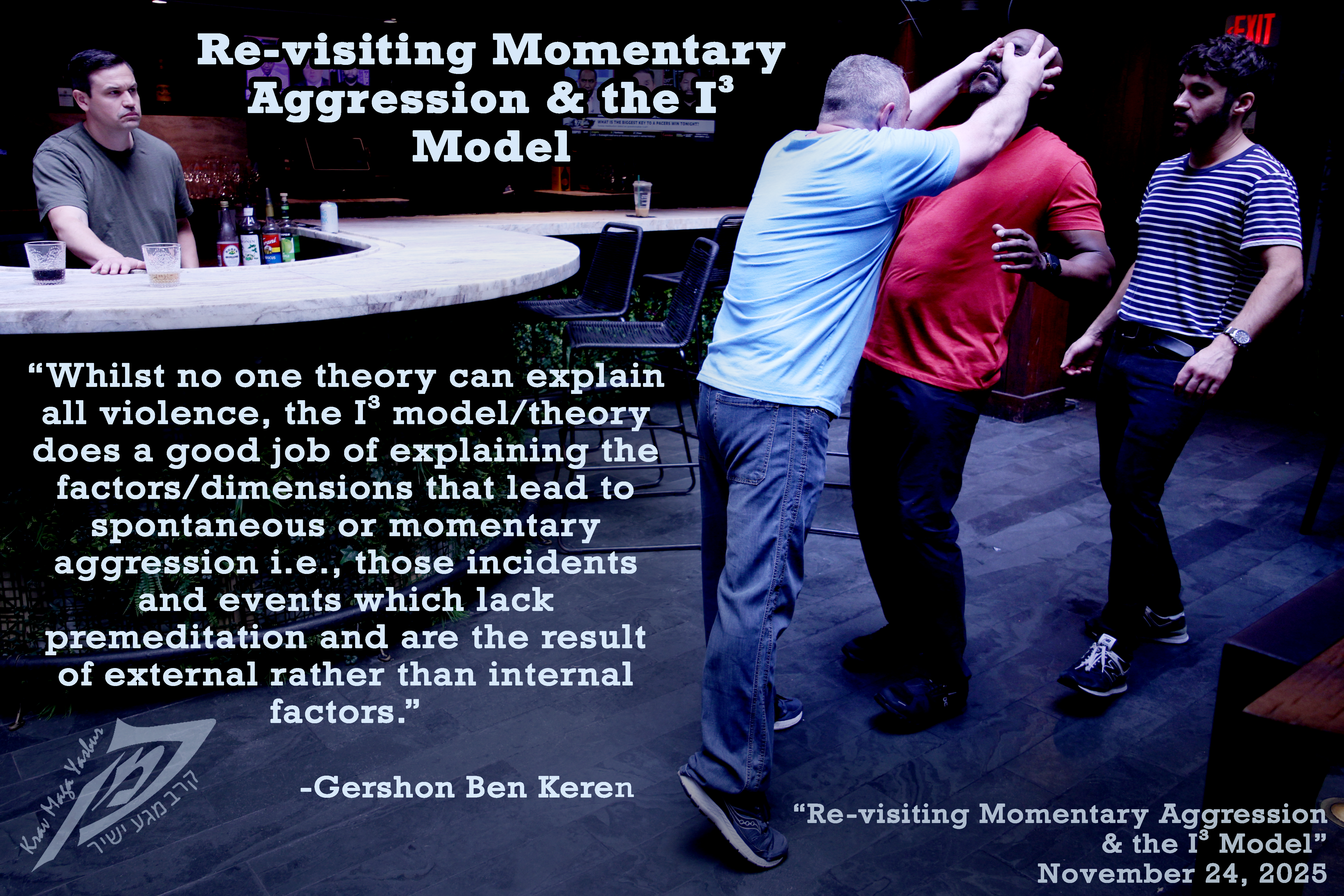
Whilst no one theory can explain all violence, the I³ model/theory does a good job of explaining the factors/dimensions that lead to spontaneous or momentary aggression i.e., those incidents and events which lack premeditation and are the result of external rather than internal factors. By understanding how these dimensions interact we may be better able to predict violence before it occurs e.g., if in South Boston at the St Patrick’s Day parade someone had been able to recognize how Instigation, Impellance, and Inhibition were converging and interacting they may have been able to take these things as a warning sign and exit the situation before things turned physical.