Author: Gershon Ben Keren
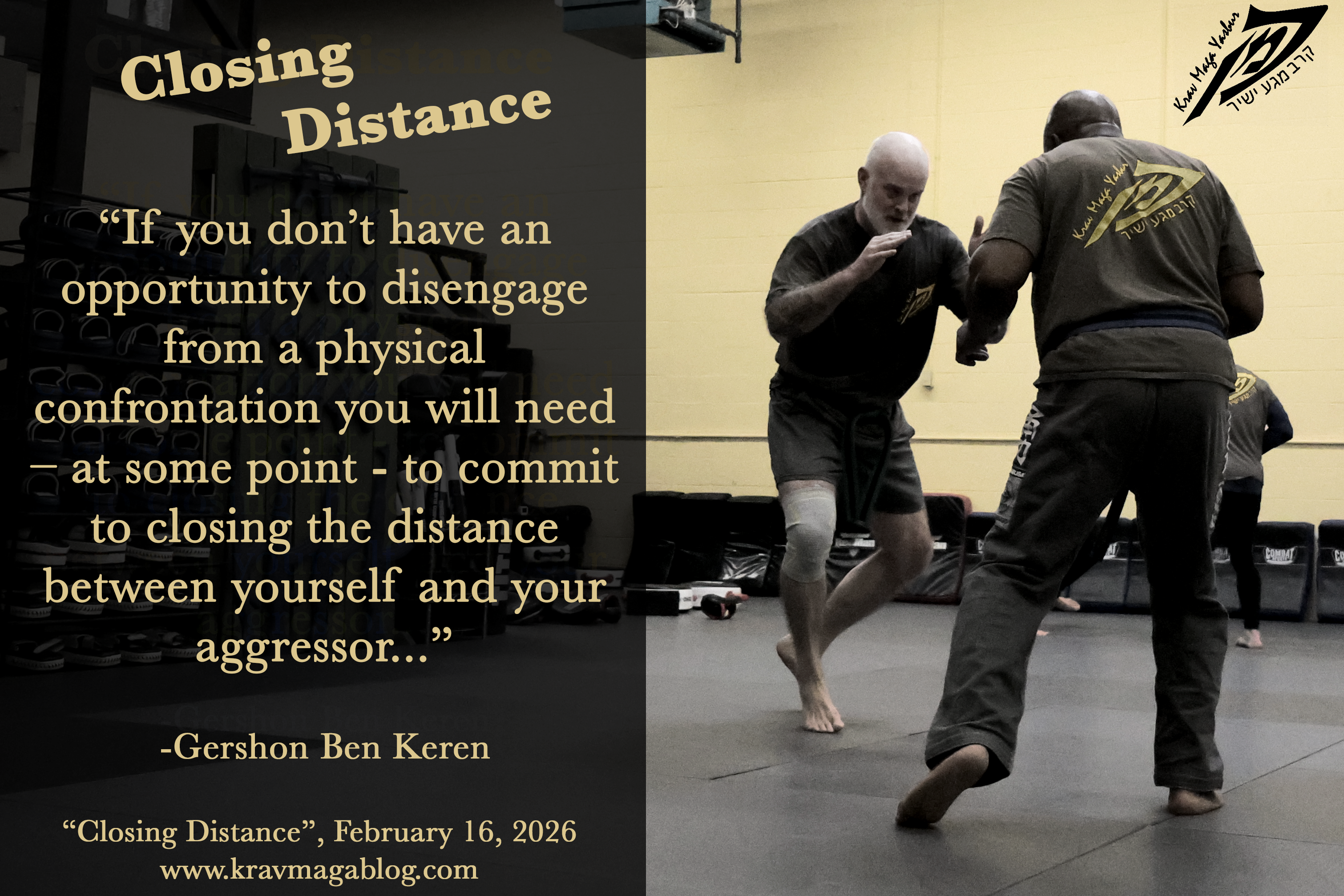
If you’ve ever watched a YouTube video of a “street” fight, between two aggressors, you’ll have likely seen a relatively long period at the beginning of the fight where both parties are staying outside of each other’s range and waiting for an opportunity to attack. Whilst this may often resemble the early stages of a boxing match, where the fighters are trying to figure out each other’s movement, management of range etc., before they commit themselves to an attack, it occurs for very different reasons. An educated/trained fighter knows how to test reactions and movements, learning how to create an opening that will allow them to close the distance and make an attack, the untrained/uneducated fighter is usually just building up the courage to make an attack, attempting to overcome their fear of getting punched/hurt as they do so. They are focusing on the negatives rather than searching for the positives. At some point one of them will decide to commit to closing the distance; how skilled they are in terms of speed, movement and timing will determine whether they are the successful party in the conflict/confrontation. If they are uncommitted to closing the distance due to thinking about the consequences, the other person may find that they have gotten “lucky” and take advantage of this hesitancy to act.
If you don’t have an opportunity to disengage from a physical confrontation you will need – at some point - to commit to closing the distance between yourself and your aggressor; you will need to move into a range where you can make your attacks, which usually means you entertain the possibility and risk of being attacked yourself. It is easy to get caught up with thinking about all the things that can go wrong when trying to close distance e.g., you get hit, you get swept, you mistime your entry etc. It is often easier to contemplate failure than imagine success. When I used to play golf, the technically easiest putts – a couple of feet from the hole, or nearer - were often the mentally toughest/hardest as there was always a sense that you could risk mucking up something that was so easy, after having achieved all the previous (harder) steps to be in such a good position. Closing the gap between you and an aggressor means taking a step which requires commitment both mentally and physically, whether that’s as a wrestler shooting in or as a boxer moving forward and throwing a jab that brings them into a range where they face a possible counter etc. It takes a certain type of courage to commit to taking that “step”.
This is one of the reasons why sparring is so important. It allows you to try finding ways to close the distance in a non-choreographed manner. Krav Maga at its root uses two types of drills, each with its own benefits. There are “closed” drills and there are “open” ones. Closed drills have definable/predictable “outcomes” e.g., you know you will be attacked with a rear strangle, and you make your escape. The drill can then be “opened” up; the attack may be a rear strangle or it could be a front choke etc. This progression starts to train threat/attack recognition and response and is the foundation of the “stress test”. However, the Krav Maga “stress test” is still ultimately a “closed” drill as the attacks and threats performed in it, although varied, are “set”. Whilst the Krav Maga stress test has benefits it also doesn’t deal with the multi-phased nature of violence i.e., after one attack/threat the aggressor doesn’t usually respond, which is necessary from a safety perspective. One of the things that stress testing doesn’t train is how to close the distance. It trains many other facets/components of the fight, but it doesn’t train/develop this skill. Sparring does that, which is why it is a necessary part of your training.
The only thing that truly/fully replicates a fight is a fight, and even if students were told to simply “fight”, they would be doing so recognizing the absence of consequence because the context would be that of a training environment. The rule book of the UFC, which promotes itself as, “real as it gets” is extensive, because although fighters have a degree of freedom to do what they want there are – and this is a good thing – safety considerations. You can train people to fight but in doing so you can never fully replicate a fight e.g., nobody will respect a “tap” on the street etc. So, to safely train people to fight in a real life situation you train the elements of it separately e.g., you develop threat recognition and decision making through the stress test, and you develop the skillset and ability for closing the distance through safe and controlled sparring. Different methods for developing different fighting skills etc. Sparring is the ultimate “open” drill where everything within a controlled frame can happen and whilst sparring develops many skills, such as effective movement, control of range/distance, how to position someone so that your strikes have full power/impact, one of the most important skills it teaches you is how and when to close distance and this may be the most important thing for ending/finishing a fight; if you can’t do this you will never throw and land that punch which was so perfect on the pads.
Sparring also involves “consequences”. You don’t close the distance effectively, you get hit or you get thrown/swept/taken down etc. Hopefully, the lesson isn’t one delivered solely by pain but by an understanding of what you did wrong. However, at some point you learn how to close the distance, how to get to your opponent successfully, without them being able to stop/counter you. You also learn to overcome the fear of failure, which helps you overcome that fear when you have to do it for real. Whilst sparring doesn’t reflect/represent what a real life violent altercation looks like it teaches and prepares you to effectively close the distance, and if you don’t have this skill, you will be relying on luck for your success.