Author: Gershon Ben Keren
There is often a disagreement amongst Krav Maga practitioners as to whether Krav Maga is a martial art or not. Personally, I’m of the opinion that it is, and that to properly progress and develop within the system you have to at some point practice it as a martial art in order to develop skills and abilities. However, it is not the purpose of this article to debate the ways in which Krav Maga differs from formal and traditional martial arts. I have several black belts in formal/traditional martial arts where the focus was on performing techniques in a clean and precise manner, and then applying them in a context like sparring e.g., where you bowed before you fought, and a referee/instructor told you when to start and stop fighting etc. Not to start another debate, but I am also believer in the value of sparring with rules, as I don’t believe you can truly train to fight, unless you in some way “practice” fighting, and sparring – when done properly - is one of the safest ways to do this. Where Krav Maga really differs from such martial arts is that we are training for real-life situations, that occur outside the Dojo/Studio/Training Center. Contexts which are often referred to as “the street”. However, not all fights will literally occur on “the street” e.g., they might be in bars, pubs and clubs, or in public spaces such as parks and parking lots. So “the street” is figurative of these locations, and shouldn’t be taken literally, as this would be to restrict the environments that we are preparing for. Because we are training for reality we must also train how to “act” in reality. This is what this article is about.
I’ll sometimes refer to this acting as the “community drama workshop” element of my classes. Being able to “play your part” in a verbally aggressive interaction/altercation can increase your chances of getting a technique to work or potentially de-escalating and avoiding the incident from becoming physically violent; something that should be our number one goal because violence is far from sexy - however the media may, at times, portray it. After every violent altercation I have had (working professionally) there would come a point/moment where I would get somewhat depressed that someone behaved and/or acted in a way that required the use of physical force, as whilst it was necessary, it could in many cases have easily been unnecessary. Unfortunately, ego (and often alcohol) meant a person’s actions would require a physical response. I often see people, when training, failing to play their part/role properly e.g., when people practice gun disarming, they’ll try to perform a disarm/control from a position of having their hands down; they are so focused on making the disarm that they want to get to the end without going through the steps necessary to get there, and one of these is raising the hands up in order to get them closer to the weapon – something which will increase their chances of getting control of the weapon. Putting your hands up is also something an aggressor probably expects you to do, so not doing so may appear unnatural and unsettling to them, and it is far better to deal with somebody who feels in control rather nervous and unsure. Nervous people are more likely to overreact and make poor judgments, something you want them to avoid when they are pointing a weapon at your head. It is worth noting that you should also practice such weapon disarms/controls from a hands-down position, as an aggressor may command you to keep them down.
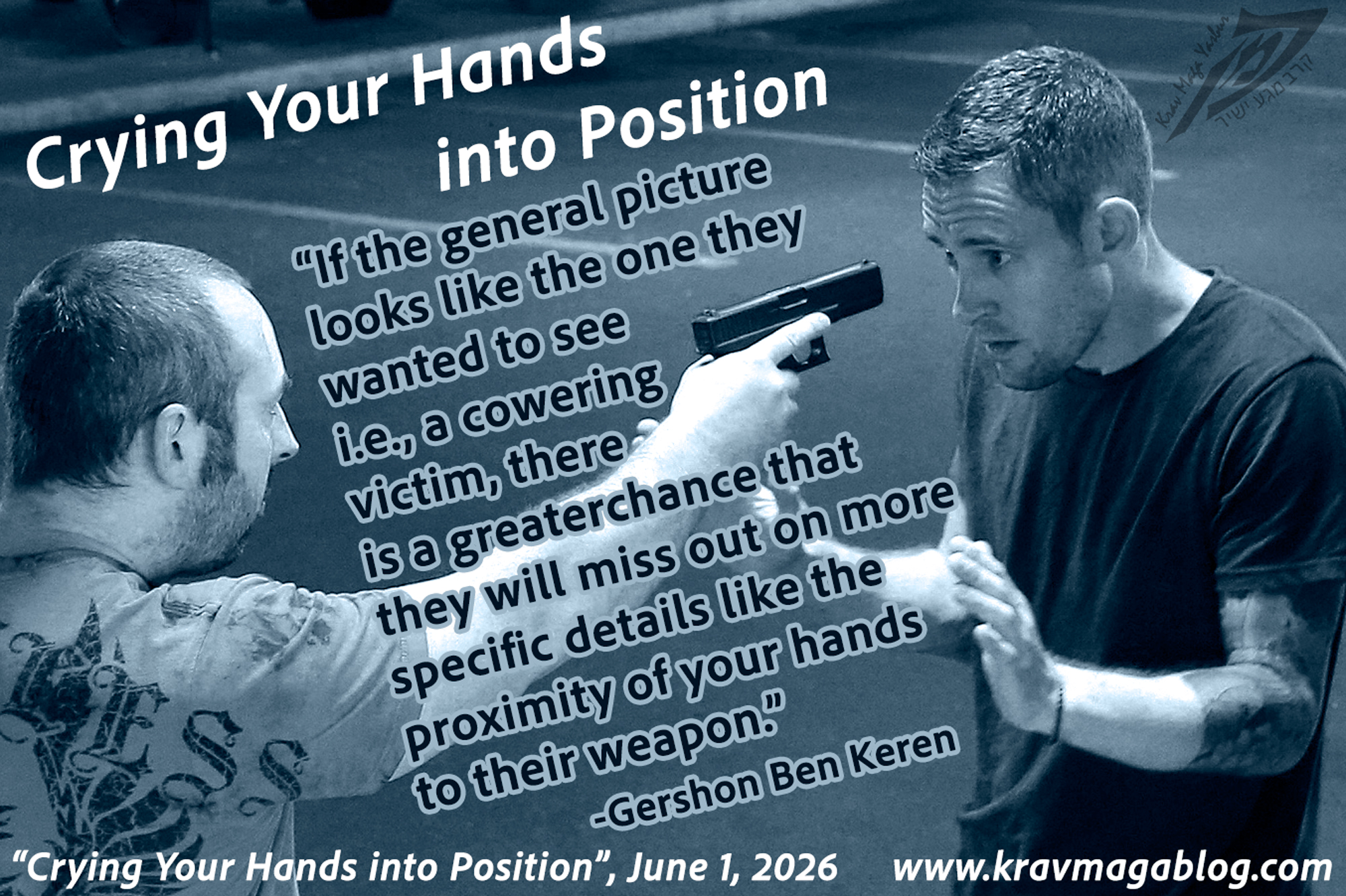
Sticking with the example of gun disarming, when you raise the hands up, your body language needs to communicate fear and submissiveness, as anything else may be interpreted as a challenge, which may mean an aggressor makes a bad decision. Putting your hands up isn’t just about raising them in the air. Your shoulders should also be “hunched” as it is this which communicates your fear to your aggressor. You can put your hands up in a relaxed manner, with the shoulders down, and still look as if you are challenging your aggressor. If you can communicate fear and submissiveness, then an aggressor is unlikely to think that you won’t comply with their demands and/or will try to resist them in some way. This may allow you to get your hands closer to the weapon than you could, otherwise. If the general picture looks like the one they wanted to see i.e., a cowering victim, there is a greater chance that they will miss out on more specific details like the proximity of your hands to their weapon. I often remind my students that when they practice weapon controls and disarms, they should forget that they are in a converted warehouse in Woburn, Massachusetts, trying to get a plastic training gun out of someone’s hand and instead imagine the real-life situations that they find themselves in, involving a live firearm. This is not to be overly dramatic or sensational but to keep the focus on training for reality, rather than training for training’s own sake. Accompanying the action of raising the hands with dialogue can also help sell the act e.g., “I’ve got money, you can have it, please take it” etc. All of this can work as a “distraction” and help get your hands a little bit closer to the weapon in case it is necessary to control and/or disarm it.
Being able to “act” according to an aggressor’s expectations, can help you set things up to improve your chances of being successful if a physical response to the incident is required. Being able to “cry” your hands into a better position also gives you a process to get your thoughts and emotions under control, slowing down the interaction, and possibly finding non-physical solutions, such as handing a wallet over, rather than immediately trying to grab the weapon etc. You can also use the act of crying your hands into position to move your body closer to a weapon if you’re at a range that would prohibit both disengagement and engagement e.g., shuffling towards an armed aggressor with your arm outstretched and your wallet in your hand, saying, “Please take it” etc. If you can get them to focus on the wallet, the fact that you are closing distance may go unnoticed. Surviving such real-life incidents involves you selling a picture, that an aggressor expects and wants to buy.