Author: Gershon Ben Keren
Obviously, the world we live in isn’t a completely safe place and will never be so. However, since the mid-1990’s crime, and violent crime have been steadily falling, albeit with some blips along the way, which begs the question of how relevant learning to protect yourself is and will be in the future, if the trend continues. This is more of a theoretical question, than an actual one, with the purpose of making us think about the ways in which martial arts and self-defense training (including Krav Maga) maintain a relevance, when people – rightly or wrongly – don’t see dealing with violence itself as particularly pertinent to their lives, especially when the focus of most self-defense programs concerns violence that is committed by strangers in public spaces, with few programs dealing with that which occurs behind closed doors, involving friends and family members etc.
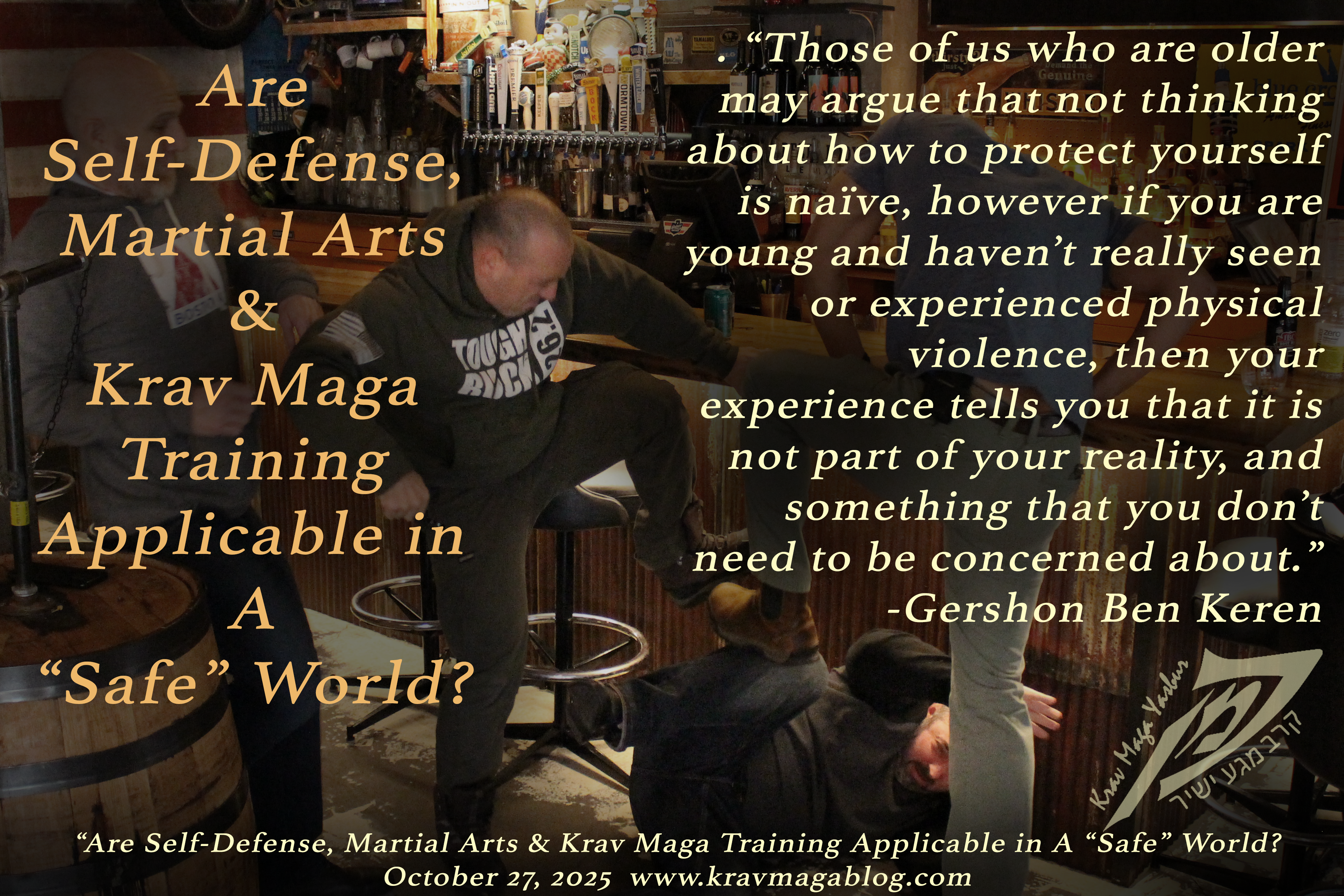
Various pieces of research show that the US population is spending more time at home than ever before (results show that from 2003 to 2022, average time spent at home among American adults has risen by one hour and 39 minutes in a typical day – Sharkey, P.: 2024), with just 30 percent of Americans spending time socializing and communicating in person on an average day, down 38% from 2014 (US Bureau of Labor Statistics). The rapid increase in the crime rate in the postwar period, until the mid-90’s was the result of lifestyle changes e.g., people had more disposable income that allowed them to engage in leisure activities outside of the home, which put them at a higher risk from violence by strangers in public spaces. If this is changing, then “traditional” self-defense programs that focus on such violent incidents will become less relevant and applicable to the population at large – especially to younger generations who have only ever experienced this stay-at-home culture. Those of us who are older may argue that not thinking about how to protect yourself is naïve, however if you are young and haven’t really seen or experienced physical violence, then your experience tells you that it is not part of your reality, and something that you don’t need to be concerned about.
There will be those instructors who teach kids and teens, who will talk about the values that martial arts training instills in people e.g., discipline, humility, courage etc. and I am someone who benefited, as a kid, from the promotion of such values. However, I have heard from several instructors that the old style of teaching e.g., “Yes Sensei! No Sensei!” etc., is being seen by many kids as corny and laughable i.e., not relatable. We can argue all we want that it is this type of training and discipline etc., that kids today “need” but if we can’t find a way to make it relevant to them, we will lose that audience and the message will never be heard. If the lives of many kids today are relatively safe from a physical perspective, and the way we communicate with them isn’t particularly effective, the old-school martial arts programs – that I grew up in – may be in danger of being seen as irrelevant. At the moment there are many adults, of the previous generation, who see the relevance of physical martial arts training, because they remember higher crime rates etc. However, when this younger generation become parents, they may not have a similar reference point and not see the benefits of martial arts and self-defense training in the same way. So, what relevance will self-defense training (which focuses on stranger violence in public spaces) have in the future?
I believe Maslow’s hierarchy of needs (a psychological theory, though not an empirically researched one) that organizes human motivation into a five-level pyramid, can help explain why personal safety training will always be relevant. It suggests that people are driven to satisfy basic needs first, and only then move on to higher-level ones e.g., until they have met and satisfied their need for shelter and water etc., they won’t address potential health issues/needs, and until they are met they won’t seek out love and belonging, and only after this has been met can they address their needs for self-respect and recognition etc., and only when these needs have been met can they think about self-actualization e.g., fulfilling their potential etc. Whilst, I don’t think all human needs can be neatly stacked like this, the general point that the pyramid makes is that until basic needs are met, we will spend our effort trying to address these before moving on to higher needs etc. I often think that the pyramid would be better represented as a jigsaw, that potentially has missing pieces/needs that need to be filled, and is somewhat flatter than a hierarchical pyramid e.g., I believe that we can crave belonging and look to fulfill that need as we look to fulfill our physiological and survival needs etc. One does not have to come before the other, i.e., we can look to fulfill/meet these three needs at the same time.
I also believe that ideas/concepts such as “security” can have somewhat different meanings to different people. For me, even though I live in a relatively “safe” society and lead a lifestyle that is devoid of many of the things that would put me at risk, simply by getting older, I still want to know how and be able to physically defend myself. Whilst the relatively safe environment that I live in means that from a practical safety perspective my security needs are met (which is a good thing), knowing how to physically defend myself meets what I believe is a primordial, basic human need for security. Without having it there would be something “missing”, and I believe many people have a certain anxiety when they think about having to potentially defend themselves, and that this anxiety can feed into others. Unlike many other species, we don’t naturally know how to fight, because physically we aren’t equipped with any natural tools, such as horns, sharp claws, or powerful teeth that allow us to do so. We have to learn how to do so; we don’t even know how to make a proper fist etc. I believe it is by meeting this internal survival need by knowing/learning how to physically fight/defend ourselves that we don’t have lose a missing piece of the jigsaw, which makes us complete.