Author: Gershon Ben Keren
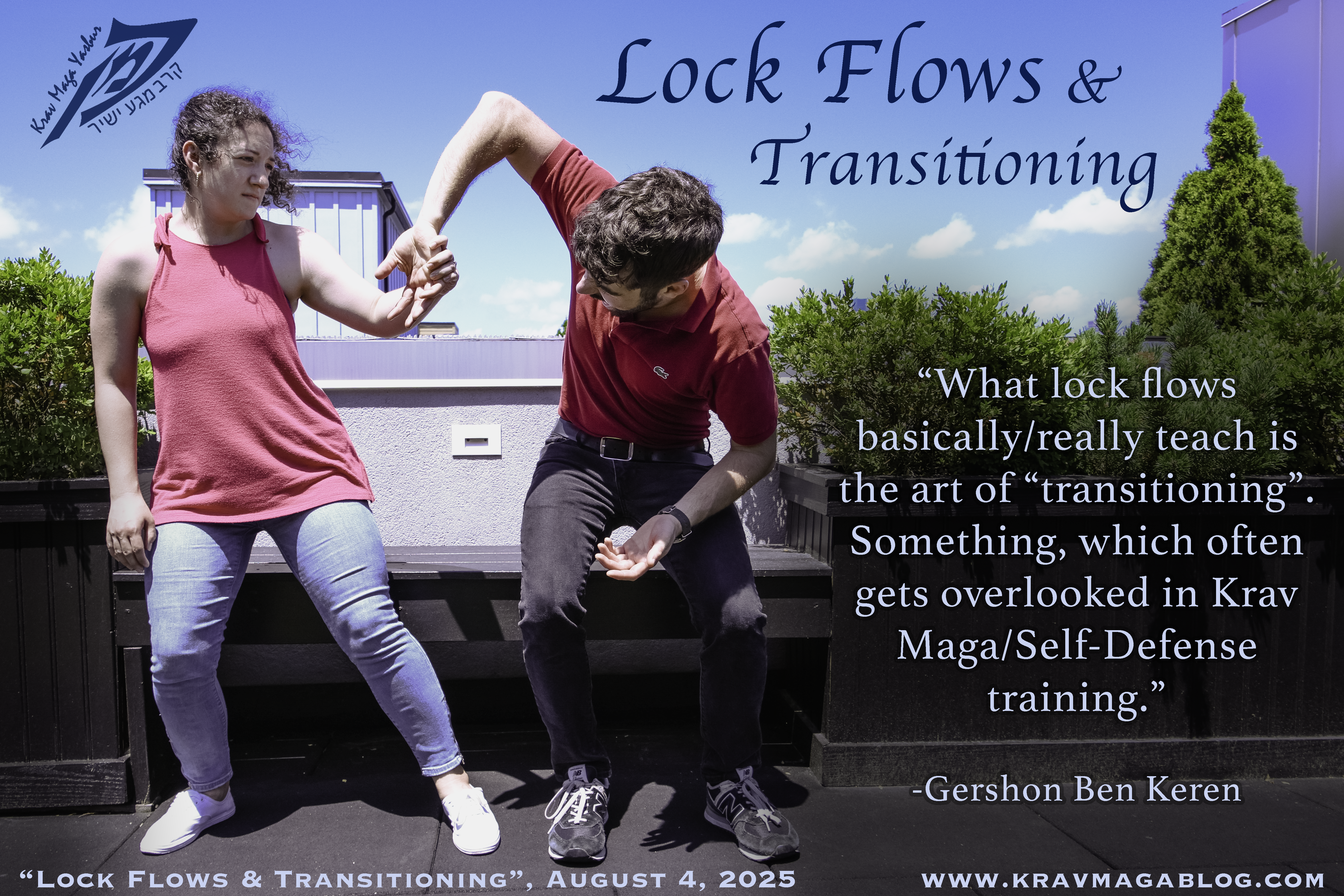
I’m at heart a grappler. I grew up practicing Judo and it intuitively made more sense to me than the striking arts I practiced at the same time e.g., I did some Karate-Jutsu, Wing Chun Kung Fu (I still remember - and can perform badly - Siu-Lum-Tao, the system’s first form) and Boxing in my teens and early twenties etc. I now understand that fighting is fighting and that the concepts used in the grappling arts have the same counterparts in the striking ones. However, for me, they were more obvious in the grappling systems I trained in, which made it relatively easy to transition from Judo to Wrestling and back again. One of the things I fell in love with when practicing traditional Japanese Ju-Jitsu was lock flow drills. This is where you perform a lock on a person’s limb/wrist etc., and then from that position transition to another, and another etc., all the time keeping control of the person you are dealing with. From a practical point of view, you might need to do this if an attacker is managing to escape from a particular lock/control; from my time working in security, I’ve found that even untrained people start to “test” and figure ways out of holds, locks and controls over short periods of time. You may also need to change a lock/control to another one because you need to change yours and your assailant’s position, such as freeing up a hand in order to open a door and escort someone from the premises etc. However, what lock flows basically/really teach is the art of “transitioning”. Something, which often gets overlooked in Krav Maga/Self-Defense training.
My experience of dealing with real-life violence involved a lot of “transitioning”. You may get “lucky” and apply a technique which deals with an incident in a one-and-done fashion but in my opinion/experience this is unlikely. It’s almost akin to landing a knock-out punch with your first strike i.e., after the first thing you do you can walk away. Such things are unlikely. Krav Maga training often appears to teach two opposing methodologies. When it comes to striking, students are taught to “flow”, moving and transitioning from one punch to another and another etc., in a continuous, unbroken stream. However, when techniques are taught, such as an escape for a rear strangle/choke, the assumption is often that this escape did the job and there doesn’t need to be a “transition” to another, and another etc. Again, this has not been my experience in real-life. In most of the incidents that I’ve been involved with, it took incremental steps to deal with the situation e.g., I would do something that bettered my situation, my attacker responded, so I responded with something that countered and possibly made my situation a little better etc., and this process was repeated until I had control of the person/situation I was dealing with. The process involved transitioning from one “technique” to another, rather than simply applying one that was conclusive. It’s one of the reasons that I prefer the term fighting to self-defense i.e., you have to continuously “fight” and “transition” from one “technique” to the next in order to be successful.
In all of my time/years competing in Judo, there’s only one time I can remember a competitor – at black belt level – stepping out onto the mats and when the referee shouted “Hajime” (begin/start), grabbing his opponent, and immediately throwing him for Ippon (the win). In every other Judo contest I’ve witnessed, there’s a fight for the “right” grip, there’s a fight to take balance, there’s usually a series of failed throws, and then at some point a competitor creates the perfect or near-perfect storm and gets/makes the throw etc. It’s a “fight” that sees both competitors transitioning from one thing/technique to another. Much of my competitive training was about transitioning from one throw to another. I was taught to understand how someone might counter a particular throw and how this could make them vulnerable to another etc. I was taught on the ground how to move from one position to another and from one submission to another etc. I was also taught how to “exploit” the vulnerabilities that were present when the other party/person was transitioning etc. Fighting is a dynamic thing that involves transitions. Simply training techniques without transitions is to never put pen to paper in a “join-the-dots” puzzle and just leave the dots on the page unconnected.
Learning how to transition takes skills, and skills take time to develop, and many people would rather have techniques answer their many hypothetical questions e.g., they don’t want to spend time developing skills, they simply want techniques that can answer the problems they believe they will face; how do you deal with four guys with AK-47s who broken into your house in the middle of the night and woken you up unexpectedly…and by the way, one of them has a Rottweiler who hasn’t been fed in eight days. When people ask me such questions my default response is usually to ask them to look at the lifestyle choices they’ve made which makes them a target for such threats/attacks etc. Learning how to effectively and efficiently transition from one position and technique to another isn’t adding to your knowledge base of solutions to various/different problems but it is teaching you how to be an effective fighter.
Only at seminars when I’m in “Shop Demonstration” mode have I successfully pulled off a seven or eight move lock-flow, but that was never my take-away from such drills. What these flows taught me was that a fight involves transitions and that if you can’t master the transition you wouldn’t get to the next lock. When Krav Maga training doesn’t take into account the need to transition and deal with other people’s transitions it quickly becomes irrelevant, as it no longer resembles reality.