Author: Gershon Ben Keren
On my first Krav Maga instructor course with the IKMF (International Krav Maga Federation), one of the instructors basically said – metaphorically not practically – that one of the “goals” of Krav Maga was to reduce every solution to attacks and threats to one technique i.e., people would only have to know and practice one thing in order to defend themselves against everything etc. The point, as an idea, is valid, but practically “impossible”. However, ceteris paribus (all things being equal) it is an idea that is worth exploring, as this “approach” may inform us of how we can solve certain problems, if not all, and enhance our training etc. It is also a good starting point to look at the differentiation between reductionism and simplicity in self-defense training, as they are often seen and talked about as if they are synonymous, when in fact they are two very different things.
There are many different approaches to reality-based self-defense. One of which is a “reductionist”, school of thought (I hesitate to use the term “philosophy” because this could be seen to elevate the idea to something more than it is), which I’m going to refer to as the, “Just Hit Them” school of thought i.e., you only need one solution to solve every problem; you just hit them. Somebody grabs you, just hit them, somebody gets you in some type of control etc., just hit them. It’s a great approach if every problem is the same i.e., violence only occurs in one context, and it’s one that many military combative programs take. If you have limited time, and a singular goal and context, teaching one solution to deal with everything saves time. Contrary, to what a lot of people believe most modern militaries teach pretty limited/reduced hand-to-hand combat programs, and that includes the instruction and training given to special forces. As an external trainer, who is brought in, usually to “demonstrate“ different solutions, rather than to “train” members of a unit, if you are given more than a couple of hours to do so, you are lucky/fortunate. Distilling/Reducing, things down to a bare minimum in such scenarios makes sense i.e., show a few simple things that a person with limited training time, and which rely primarily on aggression and commitment to act (thing that are developed generally in other “military” training areas, such as bayonet training), makes perfect sense.
In the military you aren’t given a choice not to train i.e., you have to keep training and developing etc. In civilian life training is an option e.g., a person can practice yoga rather than martial arts/self-defense. If a self-defense program doesn’t “engage” people, they will quit. If everything is reduced to a single technique/solution – if that were possible – people would stop training at a certain point (due to boredom), and when this happens their skills and abilities would start to perish and disappear; and it is these skills and abilities, rather than techniques (although important), which are what ensure a person’s survival when they’re involved in a real-life situation. There are associations and instructors, who will argue and advocate that unless an instructor is training using the “military” approach, mentioned above, that they are simply a “commercial” gym/program. There is a reason that BJJ (Brazilian Ju-Jitsu) is popular and that’s because it has the power to engage and enthrall; people are shown what is possible i.e., a much smaller person can “defeat” a much larger one, through intelligence, leverage, body-positioning etc. This is an extremely empowering and attractive message. It’s what attracted me to Judo and has kept me engaged with the practice/method for over forty-five years. If you effectively reduce self-defense training down to one technique very few people will stay engaged long enough to actually make it work. This isn’t an excuse for an expanded and irrelevant curriculum but any system to keep a student engaged must allow them the time, to become practically competent at defending themselves, by keeping them engaged. This engagement allows them the time to build fighting skills.
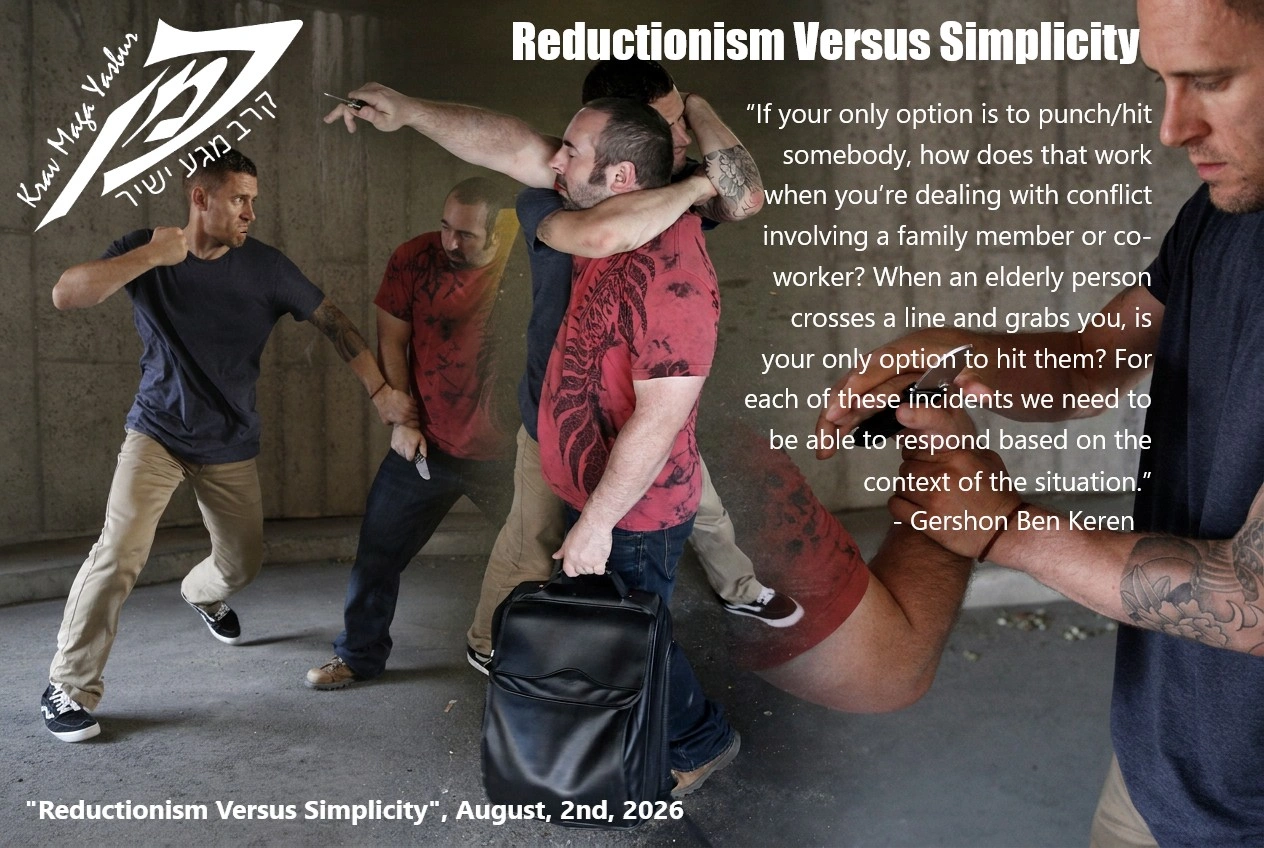
Reductionism also doesn’t work when you introduce context, and context is perhaps one of the most important aspects concerning reality-based self-defense. reality-based self-defense is not just about what physically “works” in reality, it’s about practically and effectively dealing with real-life situations. Real-life situations are often/usually more “complex” than military ones e.g., they involve the navigation of social conflicts between individuals who have different relationships with each other, rather than dealing with an easily defined enemy who needs to be dealt with in a certain fashion (I know/understand that modern militaries often have to work in “policing” roles that have their own issues etc., but I believe the general distinction stands). Having reduced options isn’t a benefit here, it’s a hindrance. If your only option is to punch/hit somebody, how does that work when you’re dealing with conflict involving a family member or co-worker? When an elderly person crosses a line and grabs you, is your only option to hit them? For each of these incidents we need to be able to respond based on the context of the situation. The “better tried by twelve than carried by six” argument, doesn’t fit when you take into account context, and reduced options/solutions force you into having to make such binary decisions. Many violent situations can be avoided and dealt with in a non-physical manner however, if you only have a hammer, every problem becomes the proverbial nail.
Those that espouse reductionism in self-defense training often quote Hick’s Law. Hick's Law (also called the Hick–Hyman Law) is a principle from psychology stating that the more choices a person has, the longer it takes them to make a decision. More precisely, decision time increases logarithmically rather than linearly as the number of equally likely alternatives increases. However, as is often the case, those trying to apply such a “law” lack the academic/psychological background to apply something that was developed in one field to another. The original study from which it was derived didn’t involve decision-making in violent situations, it involved individuals identifying which lights had appeared, after pressing matching buttons etc. These were rational choices that were made without consequences, and rational choices are not emotional choices performed under pressure and with context etc. In most “psychological” clinical trials, context is removed in order to isolate and study an individual thing/phenomenon, so when we try and apply such studies and research from academia, we need to look at the way in which the research was conducted to see whether it is applicable to the contexts we are looking at.
Should solutions to violence for every-day-people (those who didn’t grow up “living” the martial arts) be simple and “easy” to employ? Absolutely. I’ve been practicing martial arts since I was eight, but when I was called on to defend myself using physical solutions etc., I usually ended up using a few common techniques etc. However, due to a larger array of techniques and solutions I was able to employ different solutions contextually i.e., I had a number of solutions up my sleeve and wasn’t limited by only having one option. I am a big-believer in that the more options you have the better your choices can be. I can also recognize where “Hick’s Law” may create a tipping point. Too many options for too many contexts may result in inaction as we seek to find the best solution rather than the first effective one that can be applied etc. However, reductionism in the belief that this implies and equals simplicity is a naive way to look at dealing with real-life aggression and violence.