Author: Gershon Ben Keren
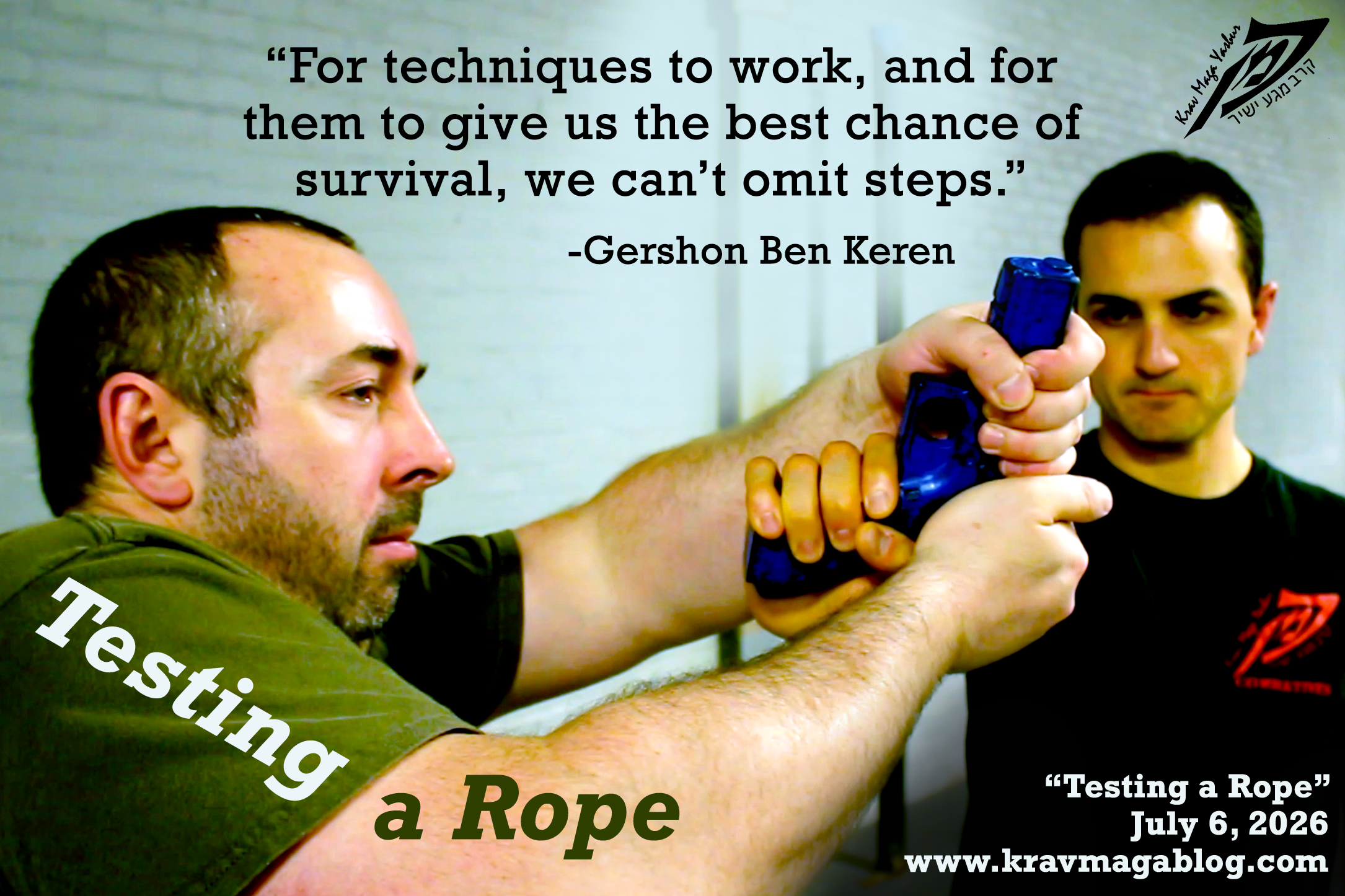
The saying, “Time exists to stop everything from happening at once,” is attributed to many different people. For me, panic occurs when people try to everything at the same time. Usually because they just want everything to be over immediately. I have written before about the importance of having an order of operations i.e., doing step one before step two, step two before step three etc. Often, when a person is practicing a technique such as a firearm disarm, they are focusing so much on the outcome i.e., removing the gun from their partner’s hand, that they neglect to get offline and get a secure control of the weapon. It sometimes reminds me of math textbooks from my school days where the answer was shown at the back of the book, and there’d be those students who would go there not to check if the process/steps they used resulted in the right answer, but simply to “get” the right answer. With all firearm techniques, if you don’t get offline and control the weapon in some way, it is unlikely that you will get to the step/stage where you perform the disarm. With most techniques the first step is the most important, as when applied correctly, it is this which gives you a “fighting chance” e.g., if I haven’t been shot and have controlled the weapon in some way etc., I stand a chance of surviving the confrontation; that’s my focus in the first instance, not the eventual outcome or “goal”. From my experience(s) of violence, situations were usually solved incrementally, rather than all at once. This is often an unpopular message as many people just want an incident/event to be solved immediately rather than have to be worked at. In this article I want to look at a step that should occur in many Krav Maga techniques, which is often overlooked or ignored in practice because people want to execute a “complete” technique in the shortest possible time rather than going through the necessary steps.
When you’re being strangled, the first - and arguably the most important step – is to be able to breathe. If you can’t breathe that is your focus, and should be, the next step i.e., how to then escape the control your attacker has on you, shouldn’t, and in reality, won’t be on your mind. A trained person should recognize what is happening and then institute a solution, whilst the untrained person will probably remain in their state of panic, hoping that something changes e.g., the person decides to let them breathe, a third-party steps in to break up the fight etc. I have worked with a fair few Russians over my career, and the saying, “There’s always hope and then hope dies”, has always summed up this way of thinking. Hopefully a trained person will recognize/understand their panic and clear the arm that is obstructing their airway. Whilst they have dealt with initial danger, many people rush their “escape”, without implementing the conditions in order to ensure and/or increase their chances of being successful. Because they can breathe and are no longer in imminent danger a form of panic kicks in and they just try to escape e.g., they may fail to identify if it’s a left-handed or right-handed attack etc., and whilst Krav Maga has built in solutions for this, an individual who turns one way rather than the other, may have complicated the situation for themselves. Before an escape is attempted the first thing a person should do is secure the arm to their chest, immobilizing it before they try to escape what is now not a life-threatening attack, but a control hold. Immobilizing the arm - by pinning it to the chest - prevents the same attack being reapplied and limits an attacker’s ability to respond/counter the escape. However, many people, even when in training mode, simply want to escape, in the fastest possible time, and often don’t check whether they are actually in control of the attacking arm.
Krav Maga is based around the re-use of common techniques, so a technique/solution against a rear strangle shares many components of a knife threat, where an aggressor is standing behind, with a knife positioned against the front of the throat. One of my oft-repeated lines when teaching is, “If a knife can’t move it can’t cut”. This means it is essential when dealing with knives to at some point take away the weapon’s ability to be moved. One of the ways I try to explain why you need to “check” or be “convinced” that an arm or knife in these types of attacks and threats can’t move is by likening it to climbing down a cliff face using a rope. After securing a rope to a solid object the first thing that any sane individual would do would be to test/check that the rope was secure before starting to climb down. If it wasn’t secure/couldn’t take weight etc., adjustments would be made before it was used. However, for a variety of reasons – some of which have been listed above, when training people make the assumption that they have the control of the arm/weapon - and so begin their escape before ensuring that the limb/weapon isn’t able to be moved. I’m not suggesting that a person begin an in-depth “testing” process before attempting to escape but one step does need to precede another etc., before an “escape” is attempted, if it is to be successful.
I hear many people talk about the need to be fast when dealing with violent attacks however the saying, “less haste, more speed” comes to mind. For techniques to work, and for them to give us the best chance of survival, we can’t omit steps, and in these types of situations, we need to ensure that the rope we are about to climb down is secure and takes our weight. We should not be so focused on getting to the bottom as quickly as we can that we miss it out.