Author: Gershon Ben Keren
For me there are no such things as “advanced” and/or “secret” techniques. Those who seek them are usually looking for shortcuts that act as a substitute for hard work, consistency, and continued training. These are often the same individuals who feel/believe that they have moved beyond the basics, and that practicing the basics is something that they no longer have to do/practice. However, physical skills and abilities are perishable. If they’re not continually practiced, they become memories rather than executable and actionable survival/fighting talents. The development of power in punching involves the co-ordination and timing of combining the shifting of bodyweight with the extension of the arm, and the clenching of the fist etc. If they’re not continuously practiced a person’s ability to perform them correctly/effectively deteriorates, as does their ability to fight and defend themselves etc. What you were able to do once is irrelevant if/when attacked now. A belt or rank that might have been significant once lacks any meaning if current skills no longer reflect it. It is easy to become complacent in training, and believe that you have already put the work in, and that this should be good enough to see you through and into the future etc.
In Karate, there is an emphasis on the basics or “Kihon” in every class, and for good reason. Practicing the foundational and fundamental skills of fighting is perhaps the most important aspect of training, and not one that should be looked on as something to fill time and/or a necessary precursor that you’re obliged to do before you get to the “new” and “interesting” stuff. Also, I would argue that attempting to make improvements on the basics is the hardest part of training, as it involves focusing on the development of something that you have perhaps done thousands of times. It is easy to go through a process of repetition – simply going through the movements – without attempting to improve each time. However, it is through such improvements of the basics that you advance. In this article I want to look at three things which if improved upon and practiced consistently with focus will advance you far more rapidly than simply adding “new” things to your repertoire. They are also the things which, should you walk into another school, that practices a different style/system etc., will mark you out as someone who should be respected, not because of your belt, your background etc., but because you obviously possess fighting abilities.
The three things you need to make sure you are training consistently – and they don’t form an exhaustive list are: keeping a good guard, moving consistently, and controlling range. I touched on some of these earlier in the year about things everyone, including myself, needs to work on, however in this article I want to go a bit deeper into them.
Hands Up!
This is so basic it shouldn’t need to be said, however having a good, consistent guard is one of the most important and fundamental fighting skills to have for a variety of reasons. If the only thing you do when someone starts throwing punches at you is to get your hands up to protect your face/head, you have given yourself a fighting chance and kept yourself in the “game”. However, often in training people get “lazy” about this, and as training progresses their hands slowly start to drop, and it is only when they get “punished” in some way that they remember to keep their guard up. However, having a good, consistent guard isn’t just important defensively, it is vital for offense as well. If a person’s hands aren’t held in a consistent position, it can be difficult for them to know how far away from them a target is, e.g., if they are in the habit of throwing punches from a variety of different hand positions, then there will be no consistent reference point, meaning that they will never know how far their hand is from the target. If when practicing punching/striking the hand is always in the same starting position this will not be the case.
Consistent Footwork
Just as with always knowing where your hands are, you should also know where your feet are, and you should know when you move them, where they will end up e.g., if you take a step forward with your front foot, where it will be, and when you move your rear foot, to take account for this movement where it will end up; and importantly this should be replicated exactly, each time you make a movement. When your front foot moves forward, your rear foot moves the exact same distance, unless you are deliberately and intentionally doing some other maneuver. If you are not in control of your movement, you are not in control of your body, and this is not a good thing if you are in a fight where you need to a proper base to strike from. Even worse, if your feet are coming together – this happens a lot when people try to circle each other quickly – then you are extremely vulnerable to being swept and/or being taken down, because not only do you create a movement that can be exploited (one foot, moving towards the other), but you have no base. I’m not saying that you don’t need to know how to fight on the ground, however if a good stance and effective footwork allow you to remain standing etc., you’ll not need to discover/find out whether your ground game is adequate or not.
Control of Range
If there was a magic pill that would make every self-defense technique – good and bad – work, it would probably be control and management of range. One of the first things I used to tell door staff when I was training teams, was that if you couldn’t manage range when dealing with someone, you risked getting stabbed. Someone at close range with a knife will have it stuck in you, without you even seeing it. Chances are you won’t even register it. There is no blocking system on this planet that can defend against such a fast movement, unless it has to cross some distance/space. If someone can make that action without having to move their body to do so, it is extremely unlikely that your reaction will beat their action; unless the “fight fairies” have sprinkled their magic dust over you, enabling you to have super-human reaction times etc. You give yourself the chance to intercept such attacks when you can control range and force an attacker to have to move their feet and body in order to get close enough to you. When an instructor – in a video - wants to show that another system’s knife defenses don’t work, they’ll almost always close distance before they make the attack. When they want to show that theirs works, they’ll put the distance back in – still trying to make out that they were caught by surprise etc., when really, they are actively managing range (something you need to do when dealing with attackers, and especially armed ones). If in a demonstration – a controlled environment – control of range is needed to get something to work effectively, then its importance in a real-life encounter can’t be stressed enough.
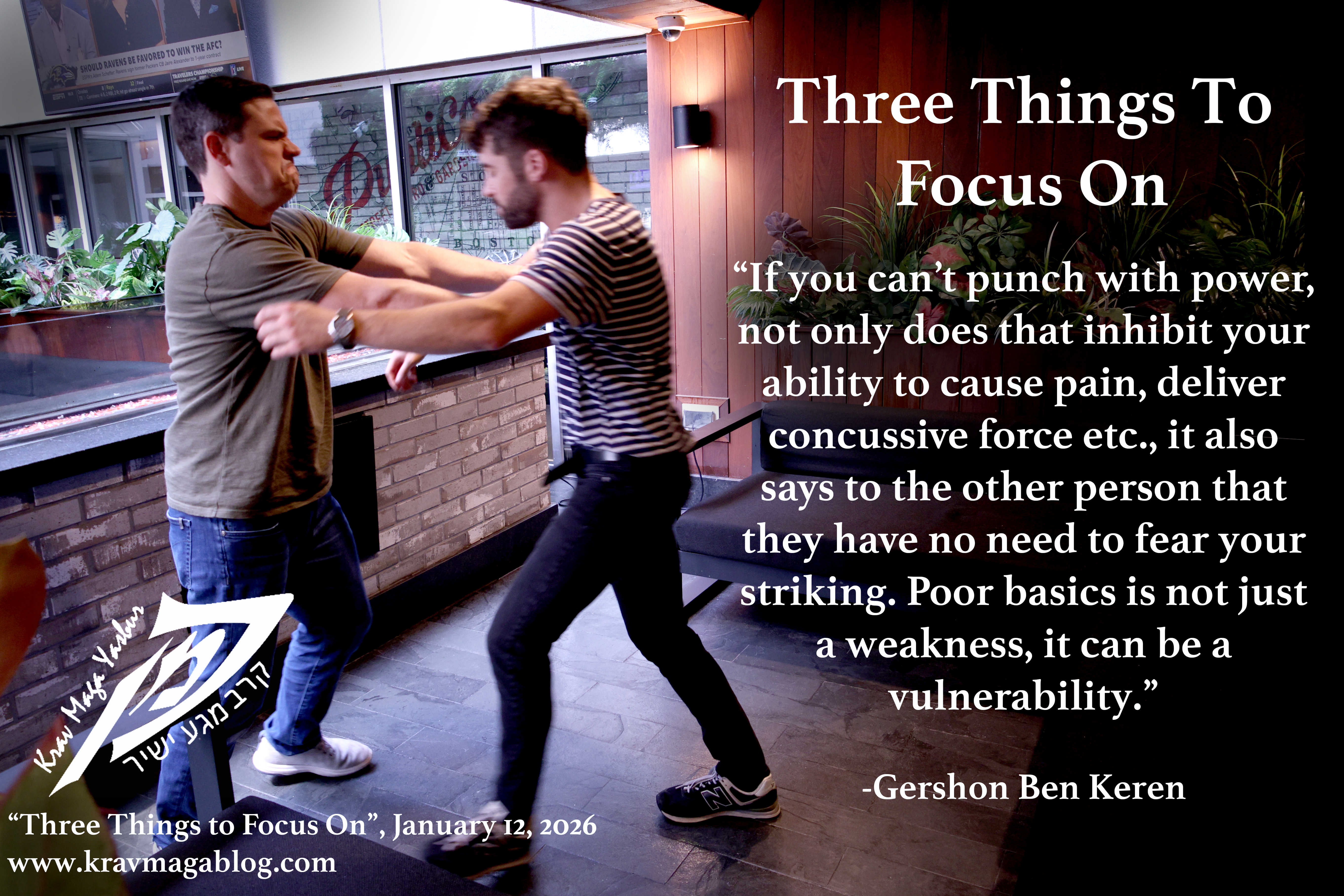
Good basics, plus aggression, and fitness, are the foundation for dealing with real-life violence. If any one of these three things is missing, or compromised, it will be a hard fight, not just because of a lack of effectiveness, but because that lack of effectiveness communicates a weakness that the other party(s) can exploit e.g., if you can’t punch with power, not only does that inhibit your ability to cause pain, deliver concussive force etc., it also says to the other person that they have no need to fear your striking. Poor basics is not just a weakness, it can be a vulnerability.