Author: Gershon Ben Keren
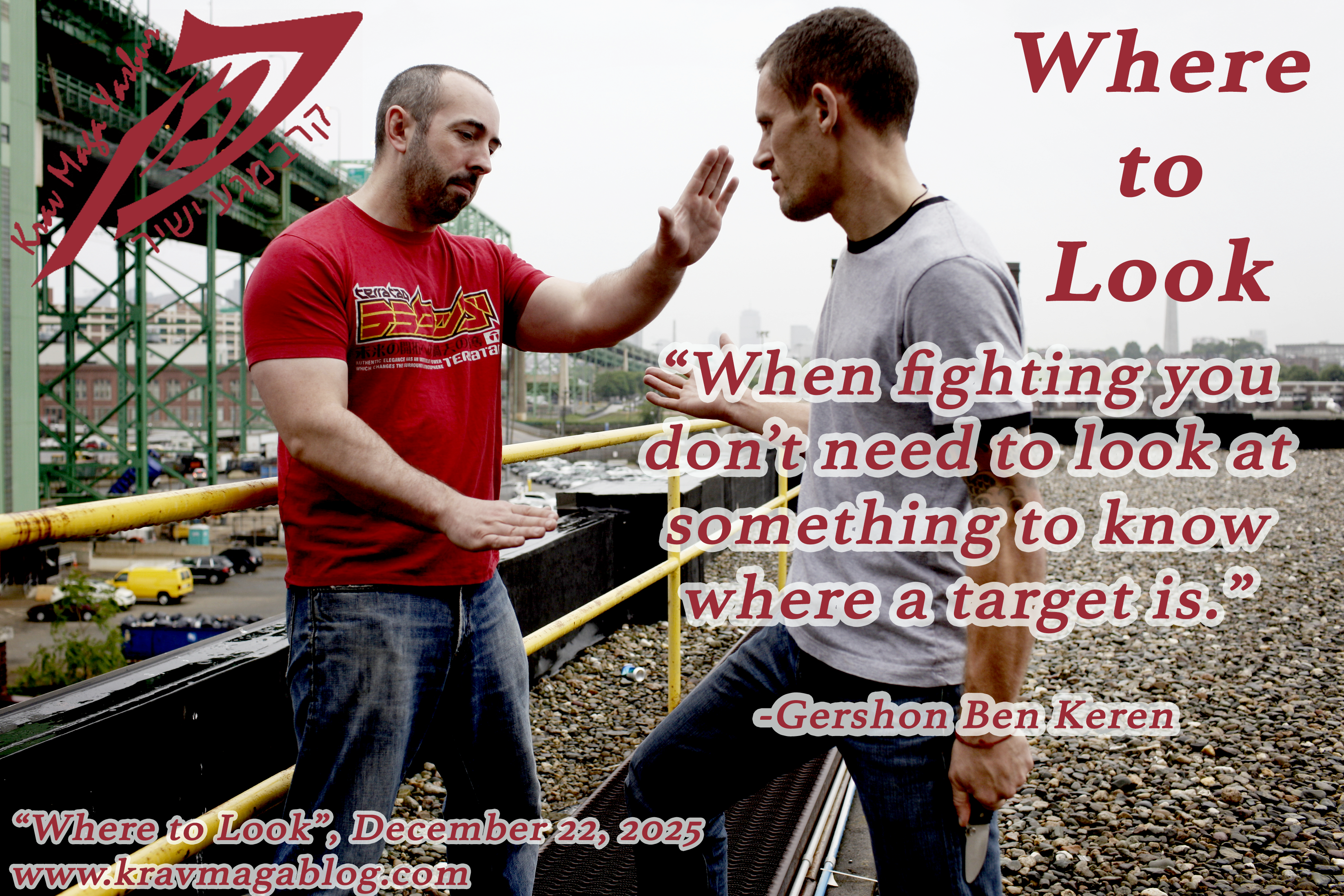
When fighting you don’t need to look at something to know where a target is. In an interview, Mike Tyson was once asked where he “looked”, and he indicated to the chest area. The interviewer asked why he didn’t look at the head, and Tyson replied that, the head can’t hit you. He knew where the target was: it was located directly over the chest/torso, and he didn’t need to see it to be able to target it. There are many rookie/novice mistakes that people make when first starting to spar, and looking at the target before striking it, is one that an opponent with a bit of experience will soon identify and pick up on e.g., before someone throws a rear, low roundhouse to their opponent’s thigh, they first glance at it, or continue to look at it as they throw the kick etc. In this article I want to look at how targets can be referenced non-visually, and where our eyes should be during real-life confrontations etc.
Sometimes you will be forced to fight “blind” e.g., if you are caught in a side-headlock or a guillotine choke etc., your face – and eyes – will be pointed towards the ground, and understanding visually what your aggressor is doing, and/or attempting to do will be virtually impossible; and you will waste time if you are attempting to visually understand what is happening to you before you can act. Using the guillotine choke as an example we can determine our order of operations; from a Krav Maga perspective. This is a “life-threatening” attack so our first priority should be to clear our airway, pulling the attacker’s arm from our throat so that we can breathe. This is also working with our natural instincts i.e., our hands will naturally come up to pull the arm away because our survival instinct(s) will kick in as soon as we’re unable to get oxygen into our lungs. This response – of bringing the hands to the throat when we can’t breathe – is often seen when someone is choking on a piece of food, even though the blockage is an internal rather than an external one i.e., the hands will be of little practical use when trying to dislodge the piece of food which is affecting the breathing. Working off another Krav Maga concept – attack should follow defense at the earliest opportunity – once we can breathe, we need to go on the attack. Using the nearest weapon, to the nearest target, means that it is probably best to attack the groin with a palm/hand strike. As well as delivering pain, this should cause our attacker to instinctively pull their hips back, taking away the “power” that is needed to perform an effective guillotine choke.
From here there are many ways to go, however if the hips have been pulled back – due to the groin strikes – it means that the attacker’s face has come down and may be susceptible to an elbow strike. At this point your head/face is still pointed towards the ground, and you won’t be able to see where your assailant’s face – the target is – however you know that, anatomically, the head is positioned directly over the groin. This means that if you bring your elbow up, along the same vertical plane that your hand is in, you will connect with the target. From here you can raise your hand up – after making the elbow strike – and staying in that same vertical plain, push your fingers into your attacker’s throat/jugular notch, which is positioned below the head/face. Again, you don’t need your eyes on the target to do this, as you are using one body part to reference another; you used the groin to reference the face, and the face to reference the jugular notch etc. This same method can be applied any time you fail to initially meet an expected target e.g., if you missed the jugular notch, you could try and get your hand onto any part of your assailant’s body. This may see you make contact with the chest, traps or shoulders etc. From here, you know how to get to an aggressor’s jugular notch; you simply work your hand inwards, and when you find the center of the chest, you then slide your fingers up until you find the jugular notch etc. Any time in a “grappling” type situation, you can’t see a target, you can use the body like a “map” i.e., find a body part, and then use this as a reference to end up where you hand(s) want to be.
One of the assumptions I make when dealing with real-life violence is that my primary aggressor is “assisted” i.e., they have associates in the environment who can come to assist/aid them – every confrontation is potentially a multiple attacker one (a good reason to learn how to avoid and de-escalate aggressive and potentially violent situations). This means that your head and eyes need to be up. You must also be able to scan with your eyes and not just by turning your head, so that you don’t inadvertently make too big a movement that takes your aggressor outside of your field of vision or allows them to move and exploit a blind spot you’ve created. In fact, often you are better changing your field of view by moving around your aggressor, rather than just using your eyes or turning your head etc.
When I talk about scanning in this manner, I’m often asked what you should be looking out for. The simple answer is movement e.g., who is moving towards the interaction and/or fight etc., as these are people who are wanting to get involved in some capacity. However, rather than actively looking you should train so that your eyes are “drawn” to the movement whilst you can still focus and concentrate on the primary aggressor before you. A simple drill to train this can involve two people engaged in light sparring (labelled A and B), within a large circle of people, and have individuals who are in the circle, step towards the pair, and take then take over B’s role, with A having – hopefully – picked up their movement so they are ready to face them front on.