Author: Gershon Ben Keren
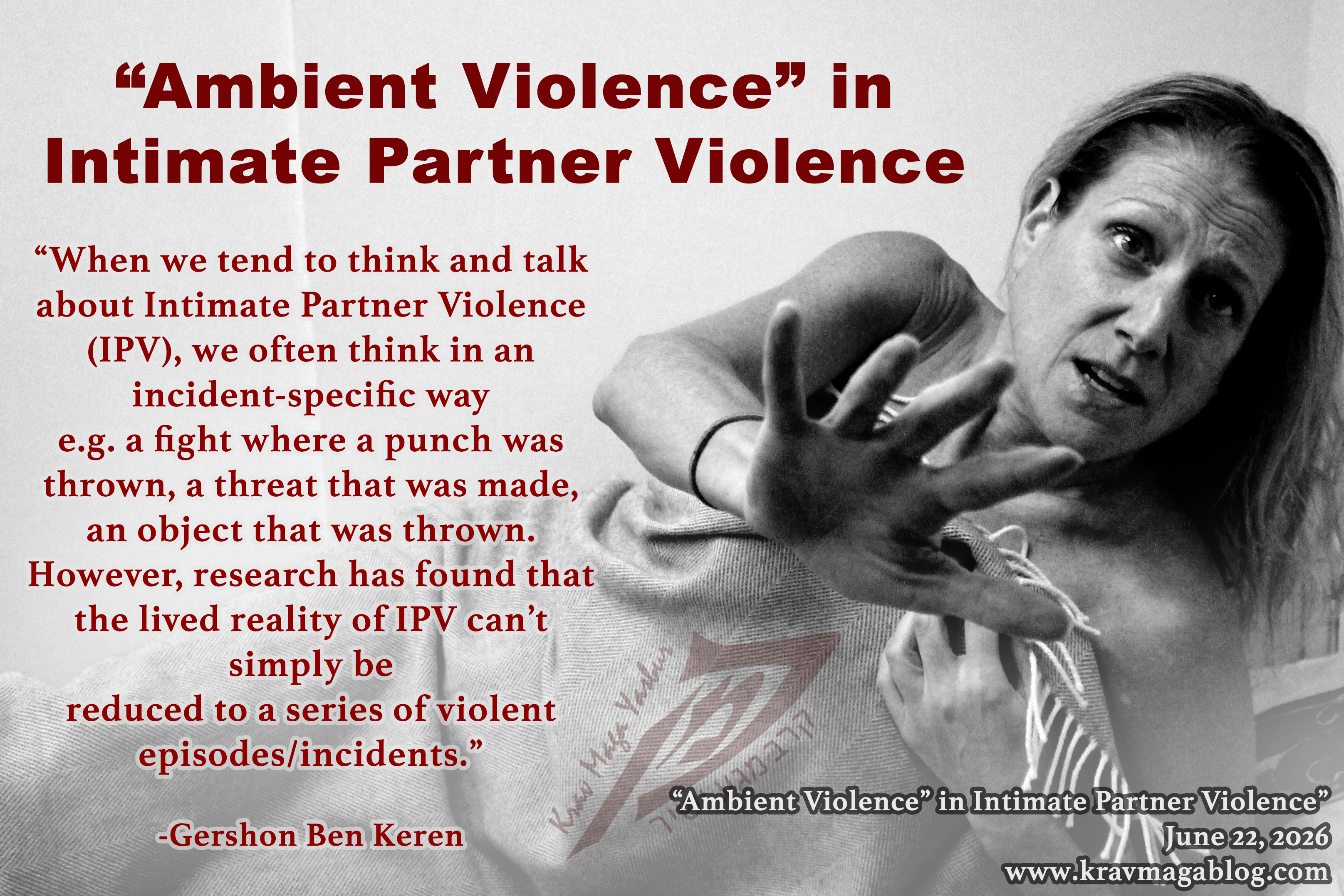
When we tend to think and talk about Intimate Partner Violence (IPV), we often think in an incident-specific way e.g. a fight where a punch was thrown, a threat that was made, an object that was thrown. However, research has found that the lived reality of IPV can’t simply be reduced to a series of violent episodes/incidents. For many survivors/victims, the most devastating part of their abuse is not the violence itself but the atmosphere in which they are made to live, i.e., a continuous, low-level, permeating state of fear, unpredictability, and the potential threats of violence that saturates their everyday domestic existence. Whilst this state of fear is achieved in a number of ways, including coercive control, intimidation and terrorization, the colloquial term of “ambient violence” describes the feelings/experiences of those who have had to live with it. Ambient violence is the background radiation of an abusive household, present even when nothing is actively happening and/or the abuser isn’t present.
The concept finds its most rigorous academic articulation in the work on coercive control, most notably in the seminal contributions of sociologist Evan Stark. In his foundational 2007 work Coercive Control: The Entrapment of Women in Personal Life, Stark argued that the dominant model of IPV as a series of discrete, individual violent incidents was fundamentally inadequate to account for the experiences of most survivors/victims. What he described instead was a "strategic course of oppressive conduct" that was designed to intimidate, isolate, degrade, and control etc. IPV was more of a concerted campaign consisting of many different factors, rather than simply a collection of events. Stark (2007) described coercive control as those repeated behaviors and actions in an intimate relationship that form patterns of dominance which are designed to entrap partners and make them subordinate. Crucially, this entrapment is sustained not primarily through physical violence but through the continuous environmental threat of it i.e., through the creation of ambient violence. This is what keeps a person in line even when the abuser is not there.
This distinction is extremely important for understanding ambient violence. The chronic tension produced by a coercively controlling relationship has been described by survivors/victims themselves as feeling like "walking on eggshells" (a phrase that has appeared repeatedly and consistently in both qualitative research and survivor testimony as the most precise available description of this ambient state). It is the pervasiveness of coercive control that is most relevant to understanding its harm. It allows the abuser to not have to engage in physical acts in order to maintain dominance e.g., a threat, the memory of past violence, and the unpredictability of the abuser's moods are sufficient to sustain a household-wide atmosphere of managed terror. A recent paper (Kassing & Collins, "Slowly, Over Time, You Completely Lose Yourself", 2026) offers one of the most detailed examinations of this traumatic environment. The paper clarifies how coercive control itself is an under-recognized form of violence that can damage one's sense of self through the ongoing deprivation of liberty and autonomy, and the creation of an environment characterized by pervasive helplessness and fear. Survivor/victim accounts in the study described individuals who were constantly in hyper-aroused states e.g., feeling "afraid," "sick with dread" etc., that are consistent with a nervous system perpetually calibrated to threats, even in the absence of any apparent and/or active danger. The concept of ambient violence captures precisely this, i.e., not individual events but a perpetual state/condition.
McLindon et al. (2025), in their development of the Psychological Abuse in Relationships Scale, argue that IPV is best understood as a chronic, repeated experience that is characterized not by individual episodes of violence but rather by an overarching psychologically abusive climate that has been created by the perpetrator to maintain control over their partner. This framing is significant because it positions the climate itself (the ambient quality of the abuse) as the primary unit of harm, rather than any individual incident within it. The scale of psychological suffering associated with this sustained environment is well-evidenced, with survivors/victims reporting damage to their identity, an impaired trust in their own judgment, states of dissociation, and the complex trauma sequelae e.g., conditions, symptoms, consequences, associated with prolonged captivity rather than acute assault.
The impact of ambient violence can also extend beyond the primary victim, i.e., the partner. Research from a recent Swiss study (2025) discovered that the impacts of IPV on children occur at different levels of the social ecology and stem not only from the experience of acute IPV events but more broadly from the daily experience of IPV, where coercive control and other types of victimization have become the norm. Children in households characterized by coercive control are exposed not necessarily to scenes of violence but to the atmospheric consequence of it e.g., the hypervigilance of the abused parent, the tension that fills domestic spaces, and the constant readiness for dealing with their partner’s mood swings etc. Research using electroencephalography (EEG) found that parents' perpetration of IPV against their romantic partners when children were under 24 months of age predicted hypervigilant error monitoring (an anxiety-driven state in which a person constantly scans themselves, others, or the environment for threats and signs of danger etc.) in children at age 8. The ambient violence of the household, in other words, neurologically restructures children who live within it, even when those children are never directly harmed.
There is also a distinctly gendered dimension to ambient violence that the research consistently surfaces. The pervasive, ongoing, background sense of threat and potential harm is experienced most acutely within the intimate domestic sphere by women in coercively controlled relationships. Women experience higher rates of repeated victimization, fear, and are more likely to be subjected to coercive and controlling behaviors than men. The inclusion of the word "violence" in domestic violence terminology automatically triggers thoughts of physical force and whilst physical violence does often occur, focusing on violence as being intertwined with physical force has negative effects for survivors/victims who faced abuse that was not primarily physical.