Author: Gershon Ben Keren
Throughout our childhood and early adult life most of us learn how to interact and function in the world in a healthy and productive manner. There are even those who would meet a clinical definition of psychopathy, who despite lacking emotional intelligence, learn to cognitively recognize other people’s emotions e.g., whilst they can’t/don’t feel another person’s sadness they are able to associate tears and a trembling voice etc., with sadness and then respond in an appropriate manner such as asking the person why they are feeling sad etc. These are the “successful” psychopaths who are able to learn how to fit in and function (the “unsuccessful” ones are the ones who behave in anti-social and criminal ways and end up being incarcerated).
Along the way, as we learn how to act and behave in a societally acceptable/productive way, we develop some biases. These help us speed up our decision-making and not become overly distracted by everything that is going on around us. However, at times, these biases can cause/allow us to miss certain warning signs, concerning our personal safety. One of the most important personal safety skills is learning how to hesitate. I am not talking about going into a freeze state, but hesitation that allows us a moment to be curious and investigate what has grabbed our attention, or to question a decision we are about to make. By understanding how some of our biases work, we can learn why we ignore and deny certain warning signs even when they are screaming at us to do something. It is also important to understand that in many threat scenarios, certain biases are working together and potentially reinforcing each other. They can also share certain commonalities and traits, so whilst we tend to talk about them and research them as distinct, discreet, individual things, they often have overlapping components.
Our Normalcy Bias in the context of an unfolding violent event operates as an active cognitive process that interprets ambiguous and/or unambiguous threat information through the least threatening explanatory framework that is available to us e.g., on 9/11 when the planes hit the two towers, people reported thinking that what they heard and felt was a boiler explosion, a construction accident, or an earthquake etc. Whilst these explanations might appear somewhat random, they were things that were familiar to the individuals who came up with these explanations, and they were the least catastrophic and so the least threatening. Our brains have been “trained” for most of our lives from non-threatening experiences e.g., most of the loud bangs that we hear are not gunshots. Our brains tend to pattern-match what we are experiencing “now” to what we have experienced before i.e., what was/is normal for us. Our normalcy bias is also connected with our “freeze” response. Many accounts of survivors who have been involved in traumatic incidents talk about the experience of knowing something is wrong whilst simultaneously being unable to fully accept what that knowledge actually means. Dr. Peter Levine's work on trauma and the freeze response describes freezing not as a passive act but as an active neurological state. One in which the body has received a threat signal, but the cognitive processing required to generate a response has been interrupted by the competing demands of the normalcy bias, informing the individual that what is actually happening is “normal” and nothing that needs to be treated seriously.
Tali Sharot's neuroimaging research, originally published in “Nature Neuroscience” (2007) established that the human brain is not merely psychologically inclined toward optimistic thinking, it is structurally organized to produce “optimism”. Using fMRI scanning, Sharot and her colleagues found that when people imagined positive future events, brain activity in the amygdala and the rostral anterior cingulate cortex was significantly greater than when they imagined negative ones. The brain, in other words, invests more neural resource in constructing positive future scenarios than negative ones. Optimism is good for our species. Optimistic people are generally more productive, healthier, and live longer etc. Optimism benefits us both as individuals and as a species. The problem, as with normalcy bias, is that it becomes genuinely dangerous in contexts where personal safety and threat assessment should be paramount to our thinking i.e., the most consequential question being not “how good might this be?” but rather, “how bad could this get?”. This is the moment when hesitation is necessary, because we are programmed to ask the former question not the latter. The psychologist Neil Weinstein also discovered that an individual’s optimism bias was strongest, the more serious and threatening the potential outcome(s) of a dangerous event/incident was i.e., the worse the outcome, the more strongly people discounted it and its applicability to them.
When placed in a situation where there are others with us, we will often look for “social proof” as to how we should act. We may feel/believe that when we hear a noise that sounds like a gunshot, we should run one way, but if everyone else is running in the other direction we don’t have the social proof to back up our decision. There are also some practical reasons why we may want to follow a different exit route e.g., large numbers of people trying to exit through a single doorway takes time (something we may not have), if it is an active shooter scenario, a compressed crowd makes for a large “target” etc. Social proof becomes more important when a situation is ambiguous, when the appropriate response is unclear, when the sensory information available is open to multiple interpretations etc. Most significantly if acting on our own assessment(s) would require us to significantly depart from the apparent consensus of the surrounding group, our default cognitive response is to look outward rather than inward, using other people's behavior as evidence about the nature of the situation we are collectively in. It is worth “hesitating” to assess if others have a correct read on the situation and not give undue weight to their confidence concerning an effective and appropriate response to a threat/danger.
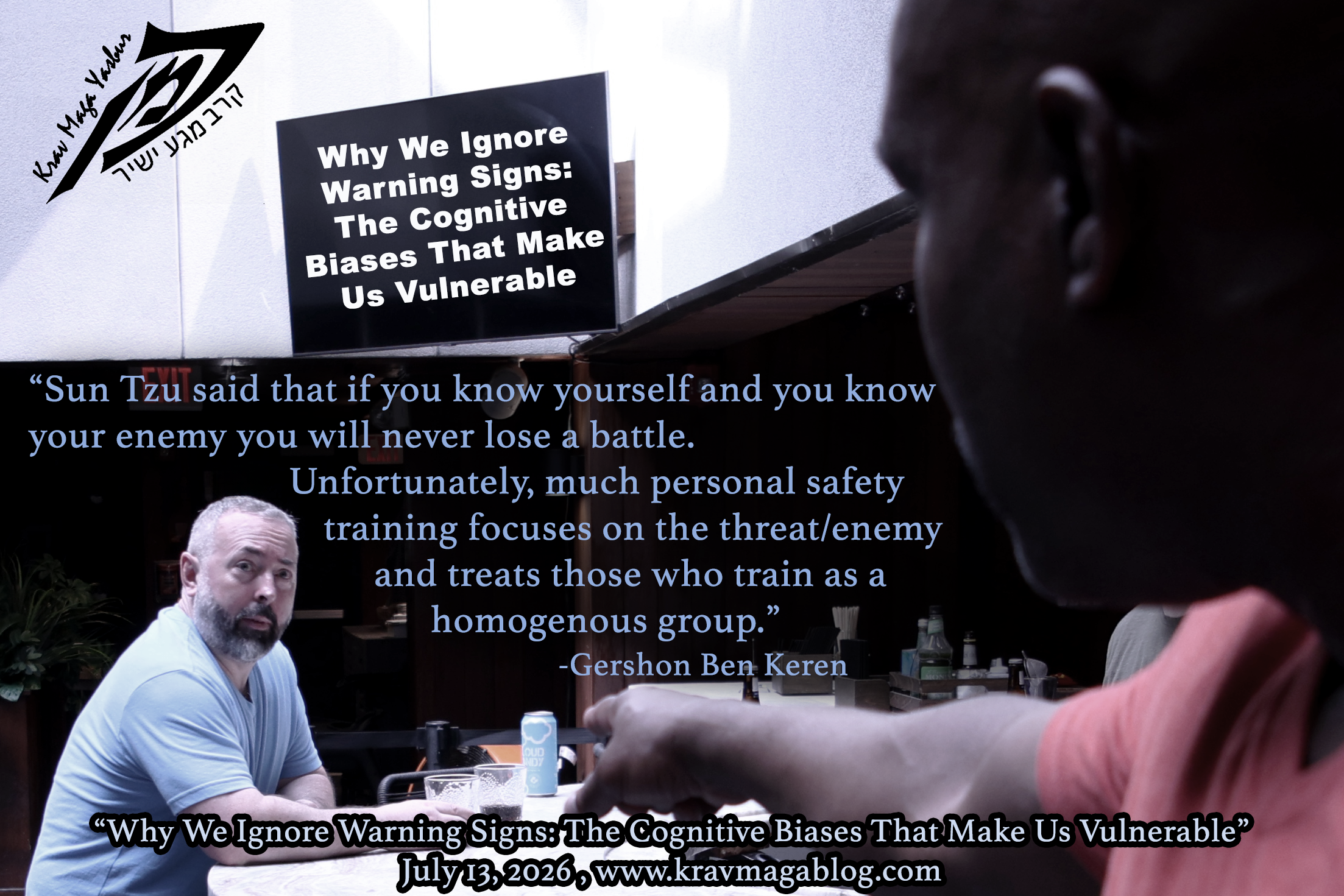
Sun Tzu said that if you know yourself and you know your enemy you will never lose a battle. Unfortunately, much personal safety training focuses on the threat/enemy and treats those who train as a homogenous group. Personal safety is a personal thing, and our biases can present larger blind spots for some people compared to others etc. By understanding how they work generally, we can start to understand how they apply to us specifically.