Author: Gershon Ben Keren
In last week’s article I looked at the need to commit to violence when dealing with physical confrontations, i.e., you need to be 100% committed to the task at hand and that means committing to violence. It would be nice to think that you could “safely” throw people away from you, without causing them any harm, such as in an aikido demonstration, whilst failing to acknowledge if the person hadn’t “rolled” away they’d be suffering a broken wrist/limb i.e., as “soft” as a particular martial art may look its goal is to cause pain and injury, rendering an attacker unable to continue the fight etc. Sometimes, when I teach various self-defense seminars, those attending are under the impression that I would do something different to what I’m teaching them i.e., that there are higher level techniques to dealing with a knife shank that would see me disarming an attacker of their weapon, whilst causing them no harm, and with them ending up in a control position, which again causes them no harm etc. Having been attacked with knives the only way I could uniformly describe my experiences would be as a “mess”; on no occasion did it ever replicate the cleanliness and precision of a demonstration in a class or seminar, even when there was no script etc. In this article I want to look at what “courage” is, and how it is viewed by those who act courageously and by those who witness such acts.
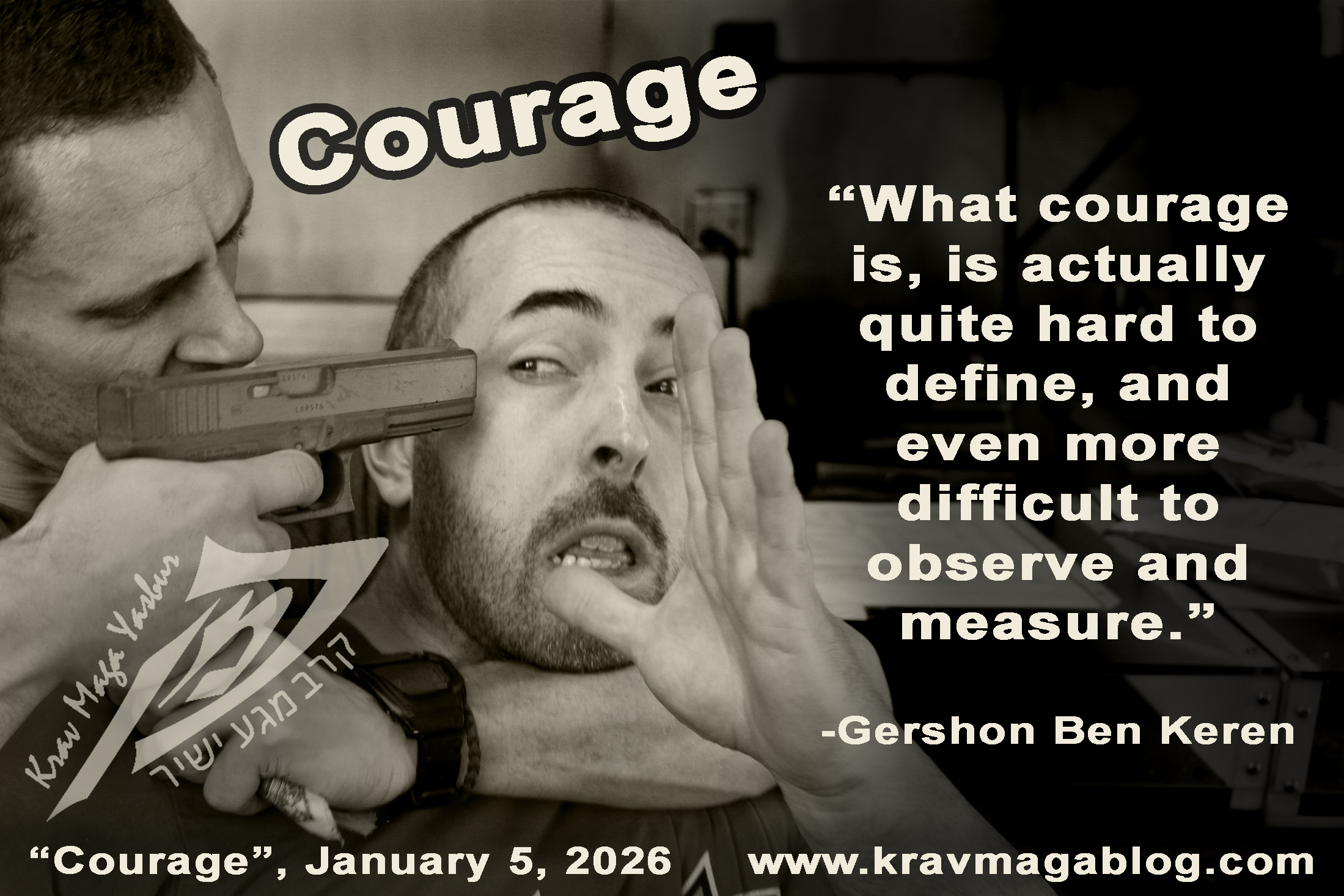
What courage is, is actually quite hard to define, and even more difficult to observe and measure e.g., when someone repeatedly returns to a burning building to rescue people it would be an extreme coincidence for a trained researcher to be there to observe this person’s actions, and highly unlikely that they’d be in a position to analyze and measure what was going on etc. One definition of courage that was originally put forward by Christopher R. Rate et al., suggested that courage was comprised of three components: (one) a voluntary action that (two) looked to achieve a worthwhile/noble goal which (three) involved taking on a risk(s). Whilst for many people, the idea of overcoming fear is part of what defines courage, many of those who commit “courageous” acts don’t mention fear as being part of their experience i.e., many people will talk about acting without thinking and/or feeling a compulsion to act, without a consideration for the risks that may have been involved etc. This may mean that the person performing an act of courage views it very differently to those that may witness or hear about it etc. This has led to the idea of there being two types of courage: accolade courage and process courage (Pury et al., 2024). “Process” courage is that which is experienced by the actor, which may or may not involve fear, whilst “Accolade” courage is how the actor’s actions are viewed by others etc. Whilst something may be looked on as high-risk by others (Accolade) the individual(s) performing such actions may not have considered the risks involved.
Training courage is a difficult thing, however Dr. Jim Detert (University of Virginia), suggests that it can be done in a similar way to exposure therapy e.g., if you are afraid of snakes, you first go and watch a snake behind glass; as you become more comfortable with that, and someone explains what a snake’s various movements mean, you put yourself in a room with a snake and someone who can handle it, and then at some point you stroke or touch it etc., with the eventual goal being that you handle it, yourself. Interestingly, there is a beta-blocker that is used in reconsolidation-based phobia treatment called propranolol, which works by blocking β-adrenergic signaling during the memory’s re-storage window (when administered immediately after reactivating the fear, such as having a controlled encounter with a snake). The emotional “charge” of that fear – a fear of snakes - can be markedly reduced at later tests with extremely long-lasting effects. Unfortunately, when it comes to the fear of violence, and developing courage, violence is too multi-faceted to be limited to just one type of experience etc. However, Jim Detert’s “courage ladder” can be used to make us more comfortable with managing our fears and overcoming them.
The idea is when exposed to minor conflicts that invoke fear and/or uneasiness developing a strategy for dealing with it e.g., if you usually back down/acquiesce when someone jumps in front of you in a line (a “minor” confrontation), you may choose to confront them and remind them that you were before them – how you act in response to them should be designed to ensure your personal safety e.g., if they then get extremely aggressive towards you, you can always back down by simply saying “you can have that place in the line, but both of us know I was here before you,” etc. In most cases the person will satisfy themselves that they “won” that battle, and you will have been able to assert yourself and understand that you were the one controlling the interaction. This could see you standing up for yourself – rather than challenging people – in a workplace environment e.g., if people talk to you in a disparaging and/or insulting way, challenging them on this. It is important to challenge the tone and manner rather than on the content of what they are saying as whilst it might not justify how/the way in which they address you there may be some validity to what they say e.g., “Whilst I acknowledge that there may be some truth to what you are saying, it doesn’t justify you talking to me in this way.” The idea behind Detert’s “courage ladder”, is to start handling minor fears, that require you to be courageous, before handling bigger ones, with the idea being that when you have to act with courage in a more extreme situation you are better prepared.