Author: Gershon Ben Keren
It doesn’t matter whether you believe that the climate is changing due to man-made causes (anthropogenic activity such as carbon emissions) or due to natural ones (natural cyclical changes, such as solar variability and orbital – Milankovitch – cycles) or a combination of both. The climate is changing (the 10 warmest years on record between 1880 and now were the last 10), and as creatures who are affected by our environment this has effects upon our behaviors. In this article I want to look at some of the ways that the climate affects human behavior and how this relates to crime and violent offending. If we can accept that the climate is changing – for whatever reason – we can start to understand some of the implications that this may have on aggression and violent offending and be better prepared for dealing with it.
Often when we think of violence we do so at the individual level. Violence is personal and so we naturally look at it from a personal perspective, however it can also be useful/productive to look at violence from a societal/collective perspective. It is interesting when looking at crime surveys to identify a disconnect between perceptions involving crime/violence at an individual level and those that are involved at a national level etc., e.g., people may believe that the risk of crime and violence in their neighborhoods and individual lives is low, but at the same time believe that crime at a national level/overall, has skyrocketed etc. This often occurs when news and media reporting of extreme events such as mass/active shootings drives upwards and people start to feel existential rather than real threats etc. We might not yet be aware that climate change is going to affect violent offending rates because we have yet to consider it at a local/community level or yet made the connection between climate change and extreme/collective violence because we have yet to see or experience it. However, this doesn’t mean that the connection between the two isn’t real.
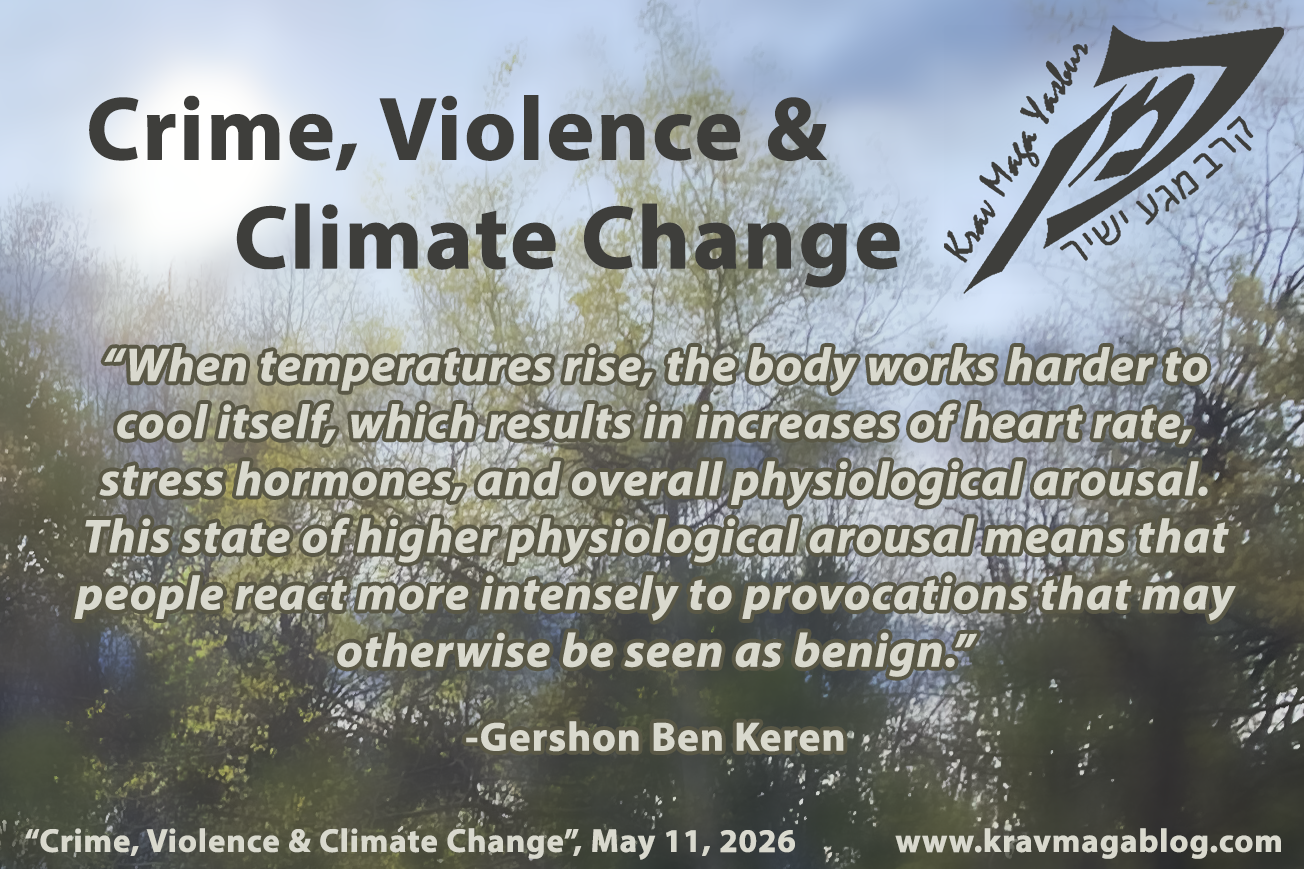
The relationship between high temperatures and violence is already well established. Choi et al., (2014), calculated that a 10°C (18°F) increase in short-term mean temperature exposure was associated with a 9% increase in the risk of violent crime. The link between rising temperatures and rising violent crime is one of the most consistent findings in criminology, environmental psychology, and public health research, along with age i.e., offenders aging out of crime. It’s not caused by a single factor, but by a cluster of biological, psychological, and social mechanisms which interact in predictable ways. Heat increases physiological arousal. When temperatures rise, the body works harder to cool itself, which results in increases of heart rate, stress hormones, and overall physiological arousal. This state of higher physiological arousal means that people react more intensely to provocations that may otherwise be seen as benign. Whilst heat doesn’t by default cause violence directly, it lowers the threshold for an aggressive reaction/response e.g., an off-hand comment, an inadvertent bump, or a simple disagreement, with higher temperatures, becomes much more likely to escalate an otherwise normal social interaction. Heat reduces patience, impulse control, and cognitive regulation. Crime involving interpersonal conflict such as assaults, domestic incidents, and fights show the strongest seasonal and temperature-related spikes for exactly this reason.
When it is hotter people spend more time outside, though this can vary by time e.g., people may spend more daylight time indoors, and more outside time at night etc. This means that more people are likely to socialize outdoors, and drink alcohol outside (always a risk factor concerning violence), gather in public spaces and stay out later (where they are more likely to be tired etc., and therefore more irritable and short-fused) and have more contact with strangers – we are more likely to feel threatened by those we don’t know (making us more “jumpy” and reactive) as opposed to those we do - even though we are more at risk of experiencing violence from individuals we know and have experience with. The more interactions people have means more potential chances for sparks to fly and confrontations to occur, especially in crowded or emotionally charged settings. This is a routine activity effect which occurs because temperature changes affect daily routines, which in turn affect offending opportunities.
Also, alcohol consumption rises with warm weather. Alcohol lowers inhibitions, increases aggression, and makes conflicts harder to de-escalate. This amplifies the heat-related increase in violent crime, especially on very warm nights. Alcohol and violence share a strong, well-documented relationship across criminology, psychology, and public health. While alcohol doesn’t “cause” violence in a direct chemical sense, it significantly increases the likelihood that everyday/ordinary conflicts will escalate, with people misreading situations that aren’t threatening/dangerous as being so, and that low-level aggression(s) will be expressed more intensely. The link is not simple, but it appears to be consistent: where alcohol consumption rises, interpersonal violence tends to follow. One of the most important mechanisms is the effect of alcohol on the brain’s executive functioning. Alcohol impairs judgment, decision-making, and impulse control by suppressing activity in the prefrontal cortex; the region responsible for evaluating consequences and regulating emotional responses etc.
Climate change and violence are increasingly understood as interconnected issues, not because rising temperatures “cause” aggression directly, but because they intensify the social, environmental, and psychological pressures that make violence more likely. As the planet warms, the conditions that shape human behavior shift in ways that strain communities, amplify stress, and heighten the potential for conflict. Extreme heat, for example, is consistently associated with spikes in interpersonal violence. Heat increases irritability, reduces impulse control, and places the body under physiological stress. It also alters daily routines, bringing more people into public spaces and creating additional opportunities for confrontation. These are small mechanisms on their own, but collectively they create more frequent moments where conflict can escalate. Beyond individual behavior, climate change has the potential to disrupt the stability of entire communities. Severe weather events, rising sea levels, food insecurity, and resource scarcity can all place additional pressure on already vulnerable populations. These are all collective/societal factors that can lead to an increase in violent offending.