Author: Gershon Ben Keren
When people hear the term “grooming,” they often imagine an adult gradually preparing a child for sexual abuse. Whilst this is one important form of grooming, the underlying process is much broader and targets a variety of audiences. Predatory grooming can occur whenever somebody deliberately develops trust, access, dependency, and/or compliance in order to exploit another person(s). The eventual exploitation may be sexual, financial, criminal, emotional, or physical etc. What makes grooming particularly difficult to recognize is that many of its individual components and stages don't initially look threatening, e.g., friendship isn't threatening, giving someone a gift isn't threatening, nor is listening sympathetically to their problems etc. The significance comes from the pattern and the purpose behind it. Therefore, grooming can be understood as a process in which apparently ordinary social behaviors are used to progressively alter boundaries and make behavior(s) that would initially have been rejected gradually seem acceptable. One useful way of examining this process is through five common stages, that a predator goes through when they are grooming someone. These are : 1) target selection, 2) trust building, 3) isolation, 4) desensitization, and 5) exploitation. These shouldn't be seen as fixed steps that are followed by every predator, but they provide a useful framework for understanding how grooming works. This article is one of two, which together will cover these five steps.
Target selection is often misunderstood because it is tempting to imagine predators searching for someone who fits a particular physical profile. Whilst there are predatory individuals who do select their targets on criteria, such as age, gender, physical build etc., these are often not as fixed and/or rigid as the media might have us believe, and they are also susceptible to change, as the fantasies that drive predatory behavior change e.g., over time a sexual assailant’s fantasies may switch from young women in their twenties, to teenage girls, and then to teenage boys etc. When we understand that sex-crimes are driven more by power, control and anger than sexual desire etc., and that the target is viewed not so much as a person but as an object or vehicle, it can be seen how the “physical” profile of those who are targeted may change as well.
One of the things that many predators who use grooming look for is vulnerability. This is true whether they are targeting children or adults. Vulnerability can be situational rather than an inherent characteristic of a particular person/individual. Someone experiencing loneliness, family conflict, financial difficulties, social exclusion, or a major life transition may temporarily be more receptive to attention and assistance, than someone whose needs in these areas are already met. This is, if we have children, something that we want to consider, in how we project ourselves as parents e.g., if we drop our kids of at a sporting practice, and drive away before we have seen them interact with a coach, we may be signaling that whilst we want our kids to have a happy life, play sports, have friends etc., we may be too busy to both notice and meet their emotional needs etc. Whilst this may not be the case, it may garner the attention of someone looking to exploit our children, as they see a possible opportunity to meet an unmet need.
A predator will also be interested in practical circumstances, e.g., does this person have a lack of people around them who are likely to notice inappropriate behavior? Are they looking for approval? Do they have difficulty establishing boundaries? If the answer to these questions is “yes” they will look to gain legitimate access through work, sport, education, and family/social connections etc. This doesn't mean that victims are selected because they somehow “allowed” themselves to become vulnerable. The responsibility rests solely with the person who is looking to exploit the situation. Target selection can involve testing as much as observation e.g., a predatory individual may make a slightly inappropriate joke, ask a personal question, introduce unnecessary physical contact, or request a small favor etc., and then watch the response of the individual targeted, and possibly those around them. A boundary that is firmly defended may cause some offenders to retreat, whilst a boundary that can easily be negotiated away may encourage them to engage in further testing.
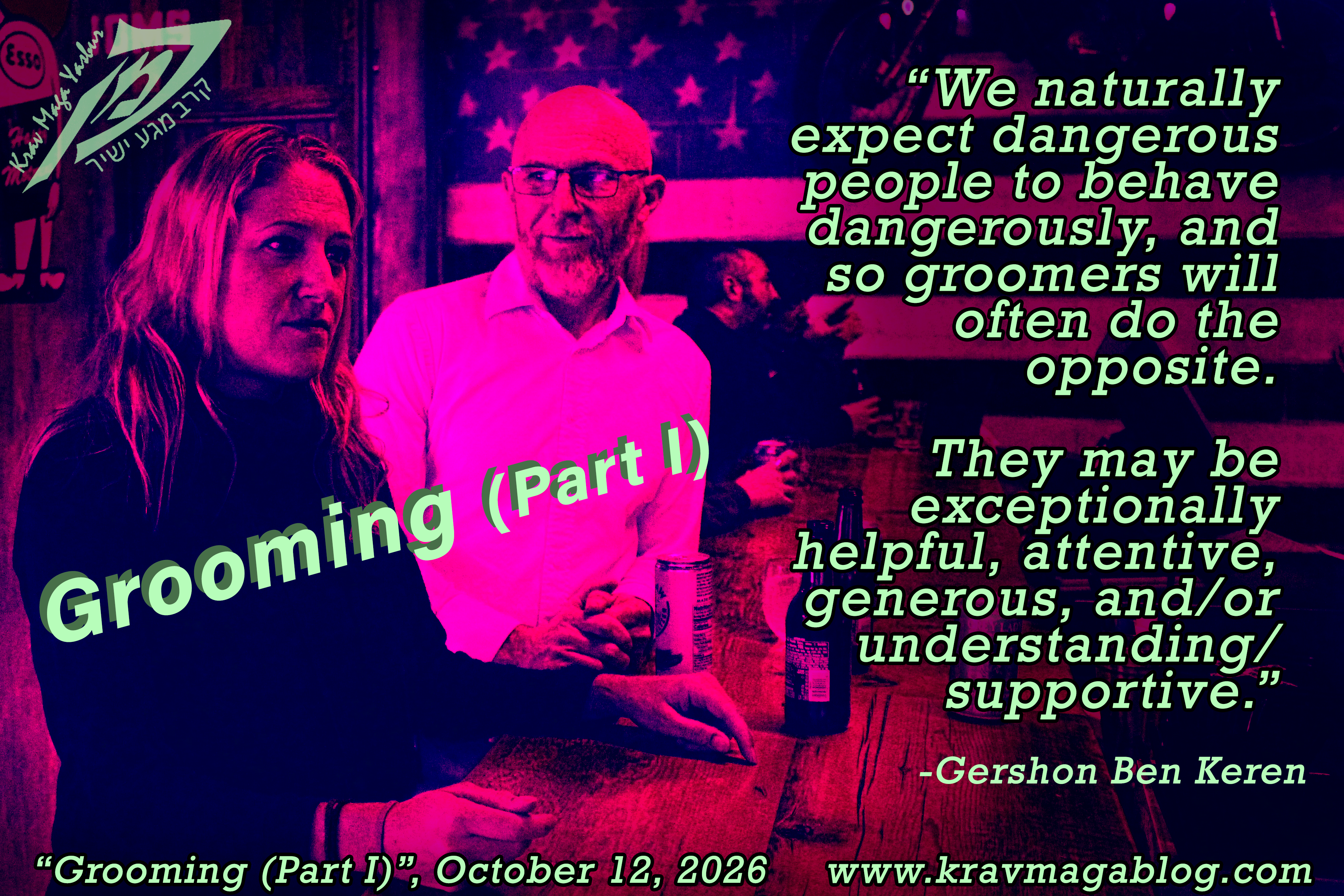
Trust building is the step/stage that makes grooming somewhat counterintuitive. We naturally expect dangerous people to behave dangerously, and so groomers will often do the opposite. They may be exceptionally helpful, attentive, generous, and/or understanding/supportive. With younger victims, an offender might take an unusual interest in their hobbies, provide them with gifts, and/or present themselves as the adult who “really understands.” With adults, trust may develop through emotional support, professional assistance, romance, mentorship, or extraordinary generosity etc. Understanding our “reciprocation bias” can become extremely important here e.g., if someone repeatedly does things for us, we may begin to feel that we owe them something in return. The predator may not initially ask for anything significant. In fact, the absence of an obvious demand can strengthen the impression that their generosity is genuine. Trust building may also extend beyond the intended victim. Someone seeking access to a child may deliberately establish a reputation with their parents, colleagues, or an organization (such as a youth sports team) as being dependable and trustworthy. This is sometimes referred to as “grooming the environment” i.e., creating a social context in which allegations or concerns will appear inconsistent with the identity the offender has carefully constructed.
In a recent article I talked about the idea of extending the perimeter from a personal-safety/self-protection perspective e.g., when working door security at a bar/club having one of the security personnel, manage the queue outside, so if there are any people exhibiting behaviors that could be deemed a threat, they can be dealt with before they get to the entrance of the building. Our personal boundaries act as one of our “perimeters”, and they need to be solid and mean something, even if that creates social awkwardness (something that predators like to create as a test of how solid they are). When a predatory individual is engaged in grooming they not only test how strong and firm our boundaries are, they also look for gaps in them that they can snake their way through. In next week’s article we will look at isolation, desensitization, and exploitation.