Author: Gershon Ben Keren
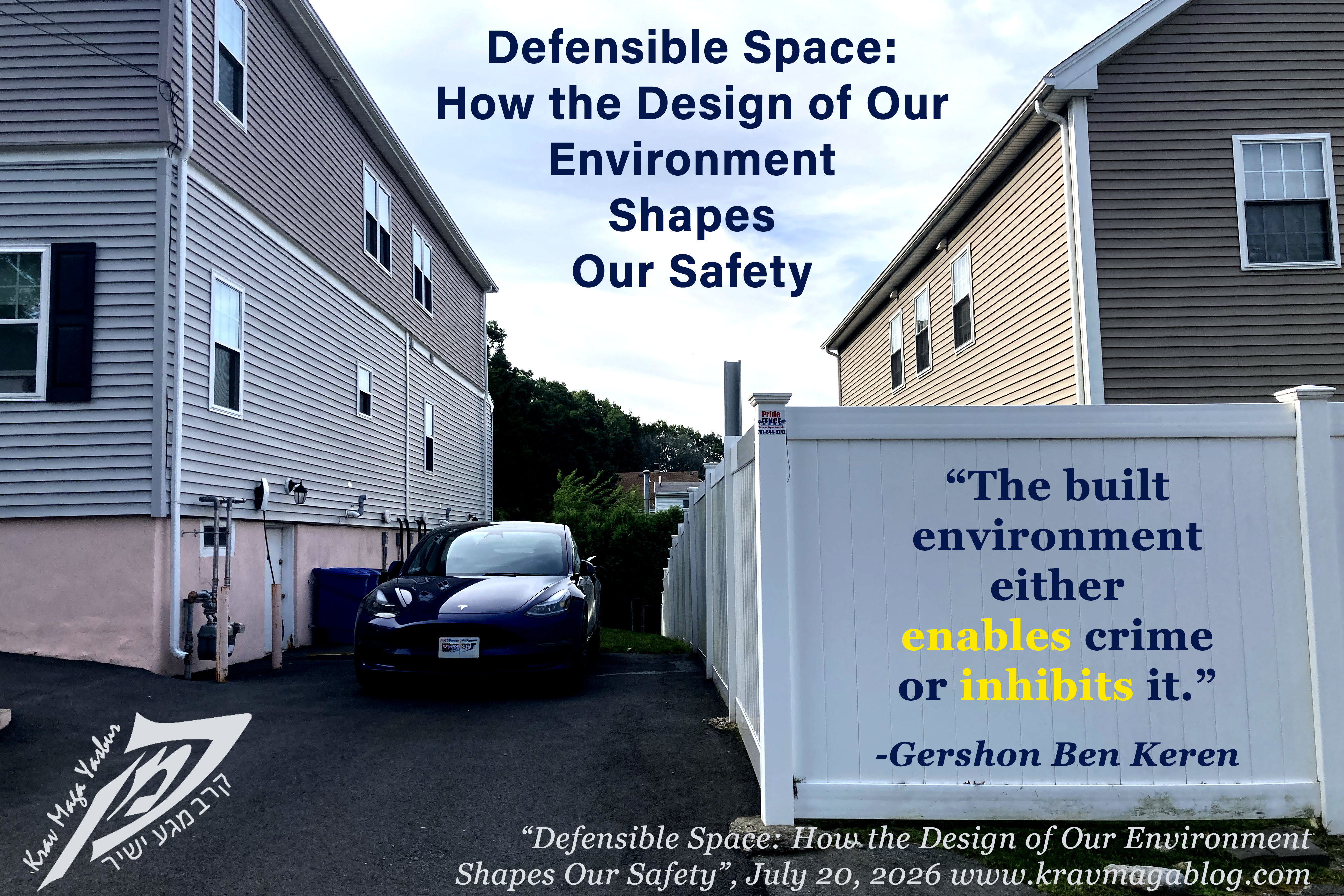
This article may at first seem more relevant to public planners than individual homeowners etc., as the research and findings came from that arena, however much of what was learnt/discovered can be applied to private properties. The idea of “defensible spaces” originated with the architect and urban planner, Oscar Newman. Newman developed his theory primarily through the comparative study of various public housing projects in New York City; in particular through his analysis of the Pruitt-Igoe complex in St Louis and the Van Dyke and Brownsville housing projects in Brooklyn. He found that crime rates varied dramatically between different projects whose residents had similar socioeconomic profiles, and this variance was due to the physical design of the buildings and their surrounding spaces, rather than the profile(s) of those who lived there e.g., High-rise buildings with large anonymous lobbies, long internal corridors, and extensive semi-public spaces that didn’t belong to anyone in particular, produced significantly higher crime rates than lower-rise developments that had clearly defined territorial boundaries, and spaces that residents could observe and feel genuine ownership of. His central argument was both simple and radical (as at the time crime was still thought to be directly related to poverty) i.e., crime is not merely a product of poverty, social dysfunction, or individual pathologies, but rather it is also a product of design. The built environment either enables crime or inhibits it.
Newman identified four core elements of defensible space, these were: Territoriality, Natural surveillance, Image and Milieu. Territoriality referred to the use of physical and symbolic boundaries in order to create a sense of ownership and belonging that discourages outsiders from treating a space as anonymous and therefore consequence-free. Natural surveillance concerns the design of spaces so that they are visible to their legitimate users, removing the concealment that certain criminal activities such as burglary require (an entry point that isn’t visible). Image was about the overall appearance of a space that showed it is cared for and belongs to people who will notice and respond to those who misuse it. Milieu is concerned about the location of residential space in proximity to other activity areas/spaces that can offer further guardianship e.g., a residential area that is adjacent to a commercial area, where shopkeepers can have eyes on the street in front of them, but can observe activities in the residential area as well. Milieu is one of the least discussed areas of Newman’s model and can be thought of as “borrowed eyes”. A good defensible space exhibits all of these four properties. His core insight/central idea is that the spaces we inhabit either communicate to potential offenders that they are watched, known, and will be held accountable, or that they are anonymous, unobserved, and therefore consequence-free.
When we look at our own properties, there are simple things we can do to make them more defensible spaces. One thing is to clearly mark the boundaries of our property with fencing and gates. The idea is less about creating a physical barrier which keeps someone out but rather marking the line between private and public spaces in an unequivocal way. Marking clear pathways that anyone visiting the property should stick to also directs people psychologically, if not physically e.g., if you have a large gravel area in front of the house, someone visiting your property either for legitimate or illegitimate areas has the “freedom” to be on any part of that area, whilst if you had a clearly marked pathway from the entry point to the front door, there would be no reason for someone to not use it. Image is also important. I remember reading an interview with a career burglar (this was when the relatively high prices of consumer goods meant there was a large market for stolen ones), talk about how he would select houses in an area. His practice was to select an area which looked like people had money and goods but then choose a house where the paintwork needed looking at and/or the grass being cut. His view was that if he was disturbed by the homeowner someone who had cared about the upkeep of the property was more likely to physically confront him opposed to someone who had let it go.
Perhaps the most important part of creating a defensible space is encouraging “natural surveillance”, by making sure that entry points such as doors and windows can be clearly observed from public spaces, and other residential properties which are in proximity. If someone looking to break in knows that they can be observed whilst doing so, it is likely they will move on to another property where this is not the case. This is one of the reasons why high fencing that blocks visibility isn’t particularly good for protecting a property from burglary, nor is overgrown shrubbery. Barring purely opportunistic burglaries, where a homeowner has accidentally left a window open, creating a vulnerability that can be exploited, many burglars line up several properties when they are looking to break-in. Being one of those properties where an offender realizes they could easily be seen breaking in, means that they move on and look for one of the easier targets on their list.
If we understand how our property relates to Newman’s four components, we can start to do things to address some of our vulnerabilities. If we couple these things with others that create a higher sense of guardianship, such as CCTV cameras, which should be visible but out of reach etc., we can add another layer of defense to our properties. Often it isn’t one thing alone that deters offenders but several that support and overlap each other e.g., creating a sense of territoriality may not be a good deterrent on its own but when combined with image and natural surveillance, they may support each other in a way that signals, either consciously or subconsciously that there are easier properties to break in to, and that the area as a whole may be one where an offender feels that they are too visible.