Author: Gershon Ben Keren
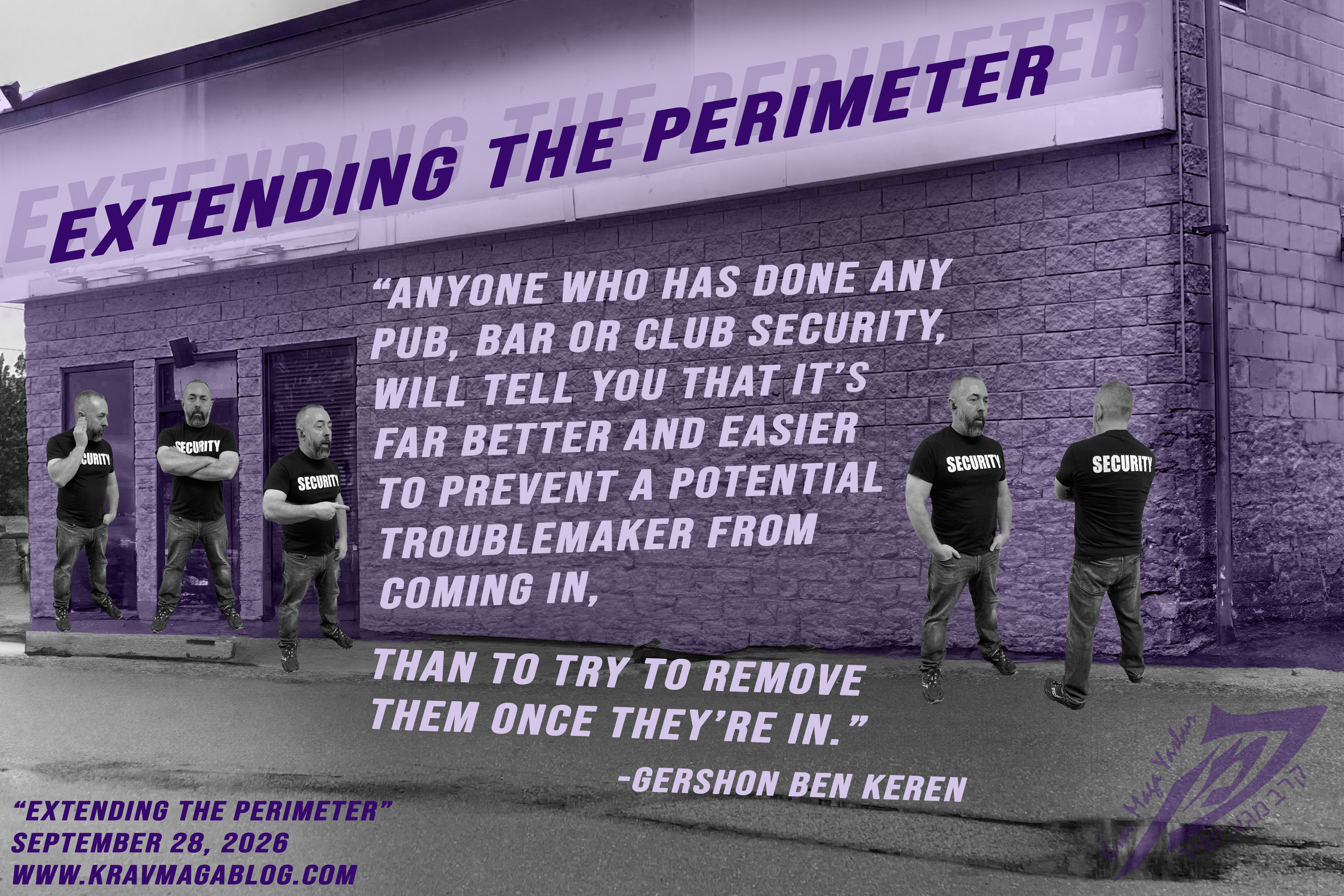
When I first moved to the US, I was approached by a club owner, who was looking to improve his security team’s skills in control and restraint. His club had been involved in several recent lawsuits with patrons who had been thrown out, claiming excessive use of force. From my personal experience, these cases often don’t actually involve excessive force but individuals who felt embarrassed, humiliated and powerless at being removed from a club by security. When I first started working door security, we were relieved when law enforcement turned up because it almost always meant assistance, however that started to change as society became more litigious, and it started to be that when law enforcement came to a club or bar it was more likely to due to a complaint from someone who’d been removed, and the possible start of a lawsuit etc. Whenever someone approaches me for physical hands-on training for a team, I like to get an idea of the context in which they are operating, e.g., for club security, the layout of the building, where the cash room is, and how the team is deployed etc. One thing this particular club didn’t do was have someone managing the queue. Their security “perimeter” started at the door and needed to be extended.
Anyone who has done any pub, bar or club security, will tell you that it’s far better and easier to prevent a potential troublemaker from coming in, than to try to remove them once they’re in. If those on the door have information about who they might want to take a closer look at, or potentially refuse entry to, before they encounter them, then they’ll be better prepared when dealing with them. Also, they won’t be having to make a snap judgment under pressure, with a line of people waiting to get in etc. All of the clubs I worked at in the Northeast of England had someone who went up and down the queue, looking for potential troublemakers. Rather than having the security perimeter start at the door to the club, it was extended out on to the street and to the queue. By observing the queue, you could also pick up on hostilities and confrontations between individuals and groups before they got to the door itself, and these could be dealt with there. It also meant that issues involving dress code could be handled before anyone had invested time queueing to get in e.g., someone who has waited twenty minutes to get to the front of a queue, only to be told that sneakers/trainers aren’t allowed in, will often argue about it because they feel that their time waiting (their investment) should be valued. If they are told when they’ve just joined the queue that they won’t be let in, then if they choose to stay, they can really have no argument when they are refused entry at the door. All of this works because the security perimeter has been extended outwards.
Unfortunately, many security systems and protocols don’t have extended perimeters and have the first security perimeter start at the entrance to the building, often in a single lobby. If you think about many office buildings, court houses and other public buildings like city and town halls etc., you often enter into the building before you interact with anyone from security. Often these places become choke points, where a lot of people gather. If you ever witness a courthouse in the US open its doors first thing in the morning, you will usually see a long line of people, moving into the lobby. It is here where most people remove belts, empty pockets, and check bags etc., before putting them on the belt of the x-ray baggage scanner, and going through the walk-through metal detector (WTMD). This can be a slow-moving process and see a relatively large number of people gathered in a relatively small area. Those targeting and planning suicide attacks understand the attractiveness of these locations as targets. Salman Abedi, who conducted the Manchester Arena bombing in 2017, understood that he didn’t need to get past security to gain access to the auditorium in order to access a large number of people. He simply waited until the concert ended and entered the building’s lobby as people were pouring out of the auditorium. He managed to kill twenty-two people. If the perimeter had been extended by placing a security operator outside of the doors, they would likely have questioned why a man with a large backpack was wanting to enter the building when everyone else was leaving i.e., by extending the perimeter he could have been engaged with before he got to his intended target.
Physical self-defense, whether it involves Krav Maga or another martial art, is reactive, where self-protection (the skills and knowledge to assess and prevent a threat from becoming physical etc.) is proactive. I once was contacted by a prominent Krav Maga instructor, with no security experience, who referred in the email, to the self-protection training and education I offer/provide as being “theory”. Self-protection isn’t theoretical especially if it’s researched and evidentially based as it should be i.e., it’s a reflection of many people’s “real” collected experiences, which together are more valuable than personal experience, which by definition has a sample size of one. As individuals we can extend our own security perimeters e.g., when in public spaces we can make ourselves aware of people who may have an interest in us, when they are at distance. Understanding what parts of a town or city have a history of violent incidents (location and history are the two most reliable predictors of violence), allows us to extend a perimeter. By finding ways to extend our perimeters we can create both time and space so that we don’t have to react to a threat in the moment.