Author: Gershon Ben Keren
In the Art of War Sun Tzu says that to win every battle you need to know who you are and who your enemy is. However, it presents an issue that every mathematical equation has, and one that is often overlooked. When you are presented with a mathematical equation each result is the same e.g., if you see an equation where on one side you have three times three (nine), and the other that says four plus five (nine), there is a danger in thinking that because they resulted in the same outcome they are “equal”. If Sun Tzu’s statement/equation is viewed in the same light, we might make a miscalculation. If we examine it from the perspective of which is more important, i.e., the method, is it more important to understand yourself or your enemy, we might get a more informed and enlightened answer.
As a criminologist, I’m extremely guilty of emphasizing one side of the equation. My starting point for understanding most crime, especially violent offenses, is to use Routine Activity Theory, which states that for an offense to occur there must be a motivated offender, a suitable victim/target, and the lack of a capable guardian e.g., there must be someone ready to commit an offense, the presence of someone who is vulnerable to have such an offense committed against them, and the absence of something that could deter such an offense being committed. However, in my academic research, I don’t focus on all three equally. I have a tendency to ignore the victimology aspect i.e., who was where, why they were there, and what made them attractive to the offender - and focus on who the offender was, why they were “motivated”, what processes/methods they used to gain access to their target etc. When it comes to the “Capable Guardian”, I rarely consider them (unfortunately this is true in most criminological research i.e., if they’re absent it happens, if they aren’t it doesn’t etc.). When I look at the equation, I don’t see both sides being equal (Aggressor and Victim), however if we were to look at it “mathematically” we should; and I’d argue that this would be the correct way to understand Routine Activity Theory (RAT) i.e., who the victim/target is, is as important as who the aggressor is. One reason for this, is that from a practical purpose, if we can understand who we are (the suitable target), we can change that (even if it’s just the perception of it), whereas we can’t change who the “motivated offender” is.
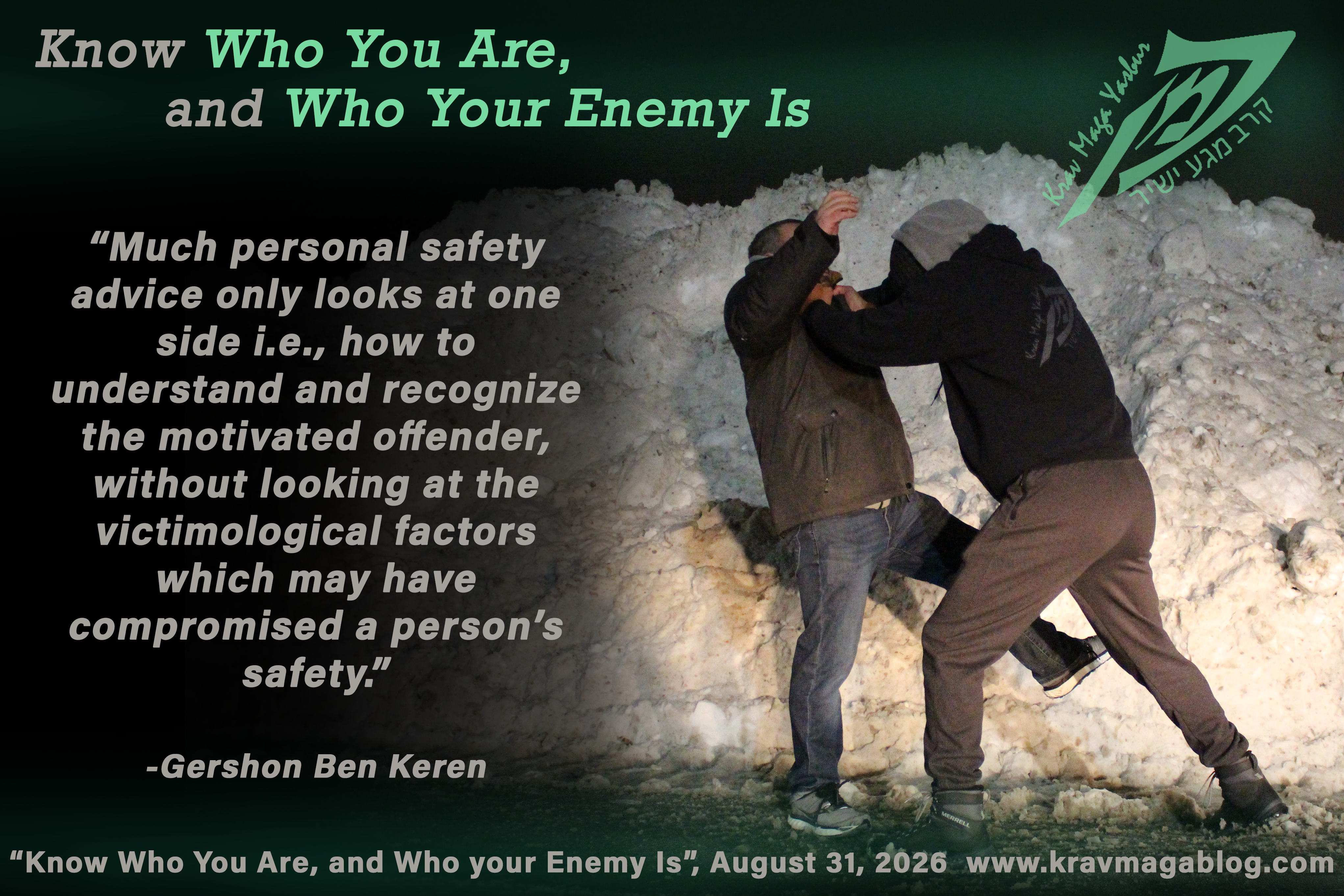
Personal safety advice tends to focus on the “Motivated Offender” however such individuals use – whether consciously or unconsciously – our weaknesses (or to put it in risk terms, our vulnerabilities) against us. We may like to believe that we are “random” targets i.e., that we were just in the wrong place at the wrong time etc., however this makes us passive players in what is an active game. This doesn’t mean that we are responsible and/or to blame for being victimized, but this approach fails to acknowledge that our actions may have aided and facilitated the offense committed against us. Both sides of the equation: motivated offender and suitable victim, are equal. However, much personal safety advice only looks at one side i.e., how to understand and recognize the motivated offender, without looking at the victimological factors which may have compromised a person’s safety. It is easy to explain away that a person was in the wrong place at the wrong time, but harder to explain why from the offender’s perspective they were in the right place at the right time etc. If we look at both sides of the equation as being equal, we fail to realize the complete story/picture. Both sides are “equal” but at the same time different. As Sun Tzu rightly said we need to know ourselves as well as the enemy. This is explaining/marrying up the equation.
Whilst there are two sides to the equation, there is a third factor which affects both i.e., the capable guardian. An important question, is when and why the capable guardian is sometimes present and sometimes not etc. The railway rapists, John Duffy and David Mulcahy, understood this very well, whilst their victims, especially Alison Day (their first homicide) didn’t; which doesn’t imply any blame on her part. Both Duffy an Mulcahy understood that there were days and times of day, when certain railway stations were uninhabited, both from official staff and regular passengers etc. They knew when there was a “lack” of capable guardians. Alison Day wasn’t viewing the train station from this perspective/angle, she was viewing it as a transportation point, that would allow her to spend time with her boyfriend who was working a late shift at a nearby factory. She wasn’t viewing herself as a potential victim, or considering being targeted by predators i.e., she didn’t “know” herself or her enemies, or those who could act as capable guardians. The equation is rarely equal (though it is), in that predatory individuals are more likely to understand it, than those they target.
Risk occurs where assets, threats and vulnerabilities intersect. However, there is often a tendency in the personal safety/self-protection world to overly focus on one side of the equation, i.e., that of threats and the way they operate, rather than look at and address the vulnerabilities they exploit etc. This is part of our human condition, to look at the bad things which can and do happen to us as being “external” and out of our control. However, the truth and reality is that bad things and threats exploit vulnerabilities which are intrinsic to who we are, and our best form of defense is usually to address them.