Author: Gershon Ben Keren
I was fortunate that as an undergraduate student in psychology I was exposed to zoology and in turn to ethology - ethology is the scientific study of animal behavior, particularly under natural conditions, with an emphasis on the evolutionary, biological, and ecological factors that shape that behavior. Ethology is especially focused on instinctive/genetically hardwired behaviors, such as fear and aggression in animals, including humans. Studying zoology and ethology exposed me to the work(s) of Charles Darwin.
When Darwin visited the Galapagos Islands, he found that many animals from varying species would approach him and the other members of the team with curiosity rather than fear and would not resist human contact if it was initiated e.g., if he was to reach out to hold a small bird, it wouldn’t try to evade his grasp and/or struggle as he held it. He put this down to the fact that they had never experienced a human before and so hadn’t learnt to be afraid of the potential danger that they faced from them. If they had experienced humans as predators, they would have learnt and evolved to be afraid of them. He referred to them as “naïve prey” i.e., animals/species who had not yet been exposed to a predator and learnt/evolved to be afraid of them.
There is much academic debate as to how much our fear systems are educated through evolution/over time, and how much through an individual’s direct experience. However, both behaviorists – those who believe that an individual’s behavior is the result of their personal experience – and ethologists who believe that many behaviors have become hard-wired responses due to evolution, acknowledge that at some point we as individuals or as a species have to learn them, and when it comes to dealing with predators, if we don’t we become naïve prey.
Human predators are in many ways different from other animals/species. We can prey on others for a variety of reasons, other than simply for food. There are other species such as chimpanzees that, like humans, engage in violence for the sake of it, with little in the way of tangible gains, however for most species aggression and violence is conducted to protect their young, territory that they rely on for food, and other pack members etc. When it comes to intragroup disputes most species have rituals that they use to resolve them, rather than turning to actual violence, which could result in serious injuries to those pack members participating and so reduce the survival chances of the group as a whole. It may be that we as a species have not developed such rituals is because potential human conflicts are so myriad and complex that it would be impossible for us to develop them.
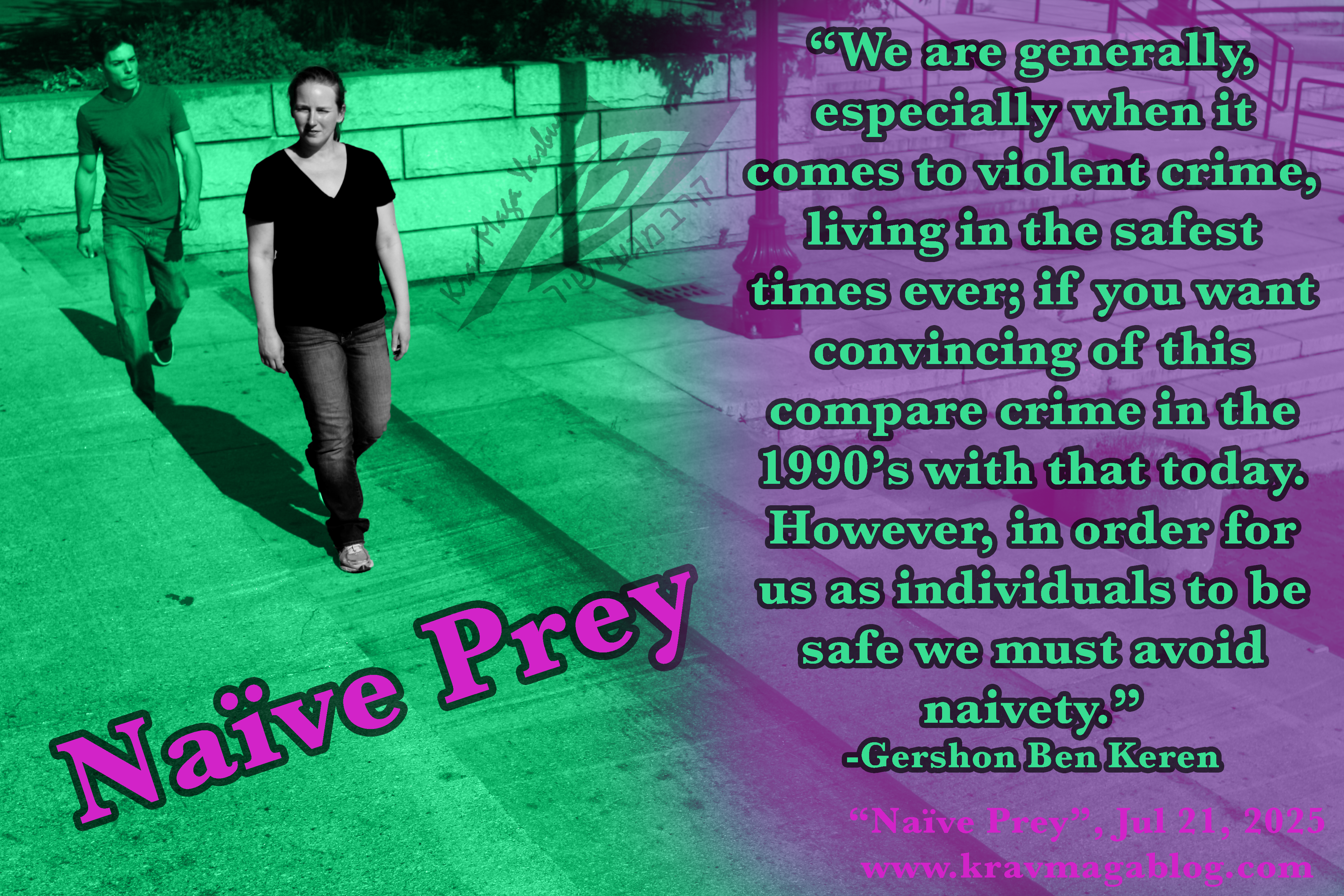
Because of this complexity we are in danger of becoming naïve prey, whether the threat is sexual exploitation or an internet scam etc. It is very easy to become naïve prey and predatory individuals are astute at identifying groups/subgroups that have yet to become educated to various threats and dangers e.g., young, middle-class kids going off to college/university for the first time may believe that everyone at university is coming from the same background as themselves and is therefore a “safe” person. Older individuals who may not be so familiar with technology may believe that an “official” looking email is genuine rather than part of a scam i.e., we are all in some respects naïve prey because unless we have been educated about a threat/danger we have vulnerabilities concerning it. Even our overconfidence or “that would never happen to me” attitude can make us naïve prey. My intent here is not to scaremonger because at the end of the day despite fluctuations in the crime rate, we are generally, especially when it comes to violent crime, living in the safest times ever; if you want convincing of this compare crime in the 1990’s with that today. However, in order for us as individuals to be safe we must avoid naivety.
The solution to naivety is relevant information and education, and some basic/foundational ideas from evolution and ethology can help us here, and it doesn’t matter to what degree we believe in these disciplines. One of these is that of efficiency. One of the reasons a species is successful and survives is down to its nutrition. A gazelle needs to graze a certain amount of grass each day in order to survive. If it is constantly looking around for potential predators it isn’t able to do so. So, it learns to recognize what is and isn’t a threat (whether this becomes hardwired or not is an academic rather than practical concern). It will happily graze in a relaxed state near a sleeping lion because sleeping lions aren’t a threat, and lions don’t hunt during the heat of the day etc. Whether through evolution or experience it knows what a threat looks like, and it doesn’t react and respond to movements, actions and behaviors it doesn’t need to. A moving lion at dusk is another matter – that’s the time to get going i.e., a gazelle is not naïve prey.
The threats and dangers that humans face are not as clear cut as that of the gazelle, but they require a similar education i.e., we don’t want to be jumping at every proverbial shadow when it isn’t necessary; like the gazelle we have tasks we need to perform and get on with so we should only be responding to actual/real threats, rather than those we incorrectly “believe” to be real. This is one of the reasons it’s important to be able to differentiate between scaremongering stories we read on the internet, which may or may not have happened, but aren’t actually relevant to our day-to-day lives and the potential threats/dangers that we are likely to face. If we are to learn and evolve our fear system(s) we will need to educate ourselves about the actual threats and dangers we are likely to face rather than the ones we imagine or simply fear the most. This is how we prevent ourselves from becoming naïve prey.