Author: Gershon Ben Keren
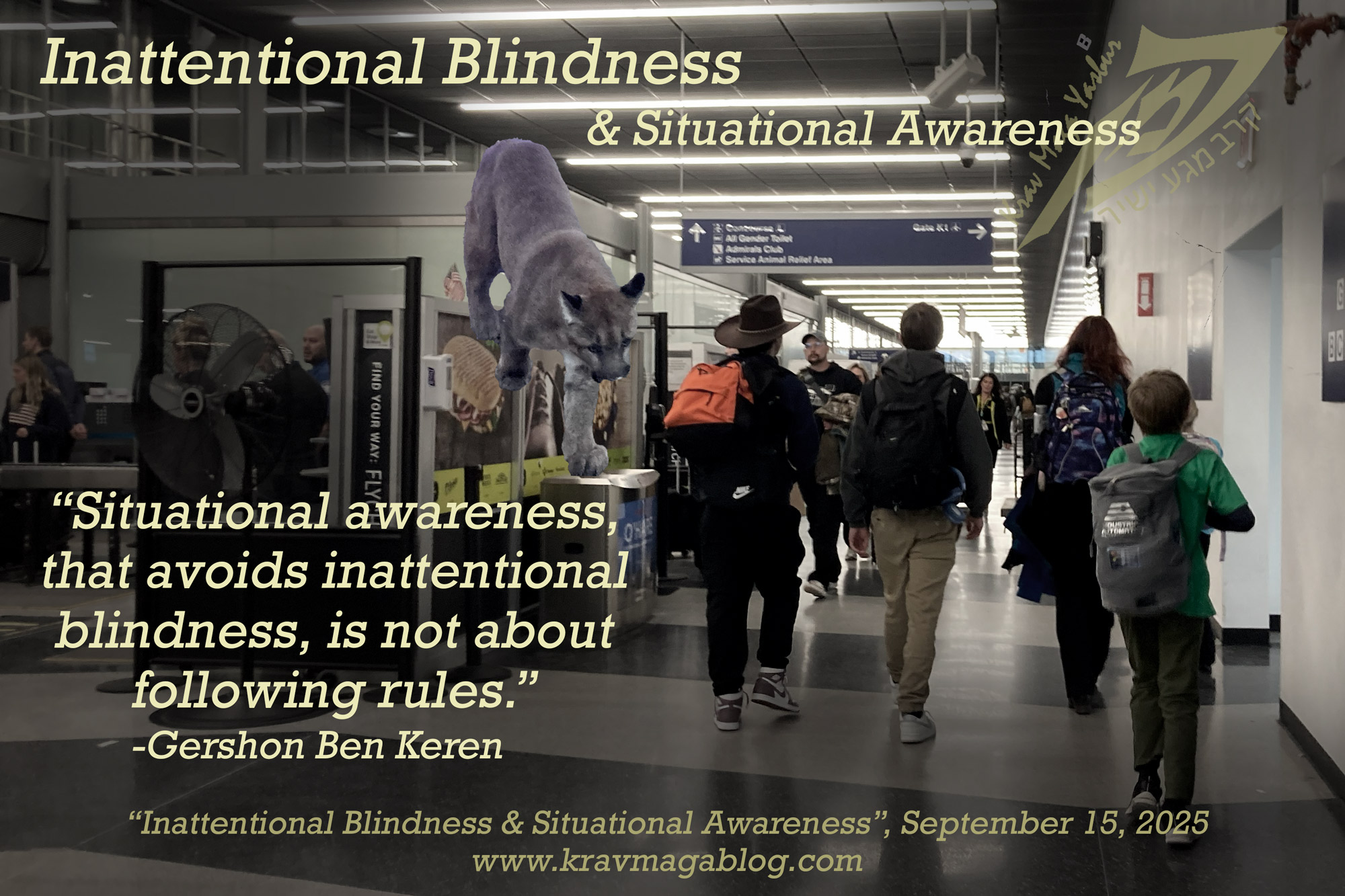
Many people are aware of the “Invisible Gorilla” experiment (Simons & Chabris, 1999). The experiment involved individuals watching a video of people playing basketball having been given the task of counting the number of passes. In the middle of the video, a man dressed in a gorilla suit walks on to the center of the screen, beats his chest, and walks of again. About half of those watching the video failed to notice the person in the gorilla suit. The experiment was an update on what Ulric Neisser referred to as “selective looking”. This idea was based on his studies and research from the 1970s, which showed that when people attend to one dynamic event they can miss another, even when it’s in plain view. Neisser and Becklen (who worked with Neisser regarding this) used similar superimposed films (e.g., ball tosses overlaid on other actions) to test their hypothesis; an earlier but related variant, to the person in a gorilla suit, featured a “woman with an umbrella” walking through a scene, which many observers failed to notice. This phenomenon of what is now referred to as inattentional blindness is well understood and many safety systems have safeguards around it e.g., when your luggage is scanned at an airport, every so often, a weapon is superimposed on it, to check if the person scanning it has picked it up. Inattentional blindness means that we can miss important and relevant things when we are focusing on something else.
Many airline pilots, when training in a flight simulator, won’t notice that a plane is parked on the runway, where they are intending to land. They are so involved in the process of landing the plane that they don’t pick up on the fact that they are going to crash into something. Our species is task-orientated, which in most instances is a good thing. We focus on what we are doing without distractions. This allows us to be productive and accomplish the tasks that we set ourselves out to do. However, it also means that we may not pick up on things which are relevant to our safety etc., such as crashing into another plane. This presents us with a challenge. How do we train situational awareness? Often when there is a serial criminal operating in our locale, local police/law enforcement will inform people that they need to be more vigilant and more aware. In fairness, there is little more advice they can give. However, it is flawed in two basic regards: they don’t say which actions and behaviors should you be looking out for, and if you’re looking out for very specific behaviors you may fail to pick up on/identify others, which indicate a person’s harmful intent towards you.
Often, when people talk about situational awareness they will give examples e.g., a person in a heavy winter coat on a hot day is out of place and should be considered a potential safety threat etc. Unfortunately, many people take this example as a “rule” and believe they should be on the look out for people in winter coats on a hot summer’s day etc. This could include harmless, homeless people who have to keep their belongings with them regardless of the weather. However, if you are always looking for people in winter coats etc., there is a very good chance that you won’t pick up on someone’s other actions/behaviors that signal that they may be a threat etc. From a personal perspective some of the worst advice concerning situational awareness I’ve received has come from highly trained and experienced operatives working in the security industry. They fully understand what situational awareness is and are extremely aware individuals who can identify a threat at the earliest signs/point, but lack the ability to articulate how and why they are able to do this e.g., they are reduced to explaining things as “rules”; if you see a person in a winter coat on a summer’s day, you should be suspicious etc., without realizing that this can lead to inattentional blindness; looking for the things that they later realized – after the event - identified a potential threat/danger.
Situational awareness, that avoids inattentional blindness, is not about following rules. The reason that people failed to see the person in a gorilla suit or the woman with an umbrella etc., is because they were tasked with looking for something else e.g., counting the number of passes in a basketball game etc. Situational awareness is developed through being in the moment and being curious. I will often, during my working day, look out of my office windows, and ask myself what people outside my building are doing. None of them are engaged in criminal activities. Some are getting things out of their cars, some are engaged in conversations on their phones, some are jogging by during their lunch hour etc. I’m not looking for a specific activity, I’m looking at all activities. Sometimes I see things which don’t fit in with these normal, everyday activities, and my curiosity becomes piqued – in almost all cases this results in no further action. I engage in this not because I’m actively looking to identify criminal behavior, but to train my curiosity. It also helps me establish a “baseline” of what normal behavior looks like around my office and gym/studio.
Until you know and understand what “normal” looks like, you won’t be able to identify the “abnormal” i.e., those things which are inconsistent, within an environment. At the 1950 Monaco Grand Prix, one of the drivers Fangio noticed spectators at the Tabac Corner looking away down the track (not at the leading cars, as was the norm), read it as a danger cue, braked hard, and avoided the huge pile-up around the corner, which is what everyone was looking at. In a photo, taken at the time – in black and white - it can be seen that Fangio would have seen the backs of people’s heads, rather than the “white” of their faces. Fangio hadn’t trained himself to look for this particular warning sign, but in the moment recognized it as something out of place, and possibly – correctly - indicating a danger; even though he didn’t know exactly what the significance of it was. Situational awareness is about being in the moment and responding to events, rather than looking for specific things which could result in inattentional blindness.