Author: Gershon Ben Keren
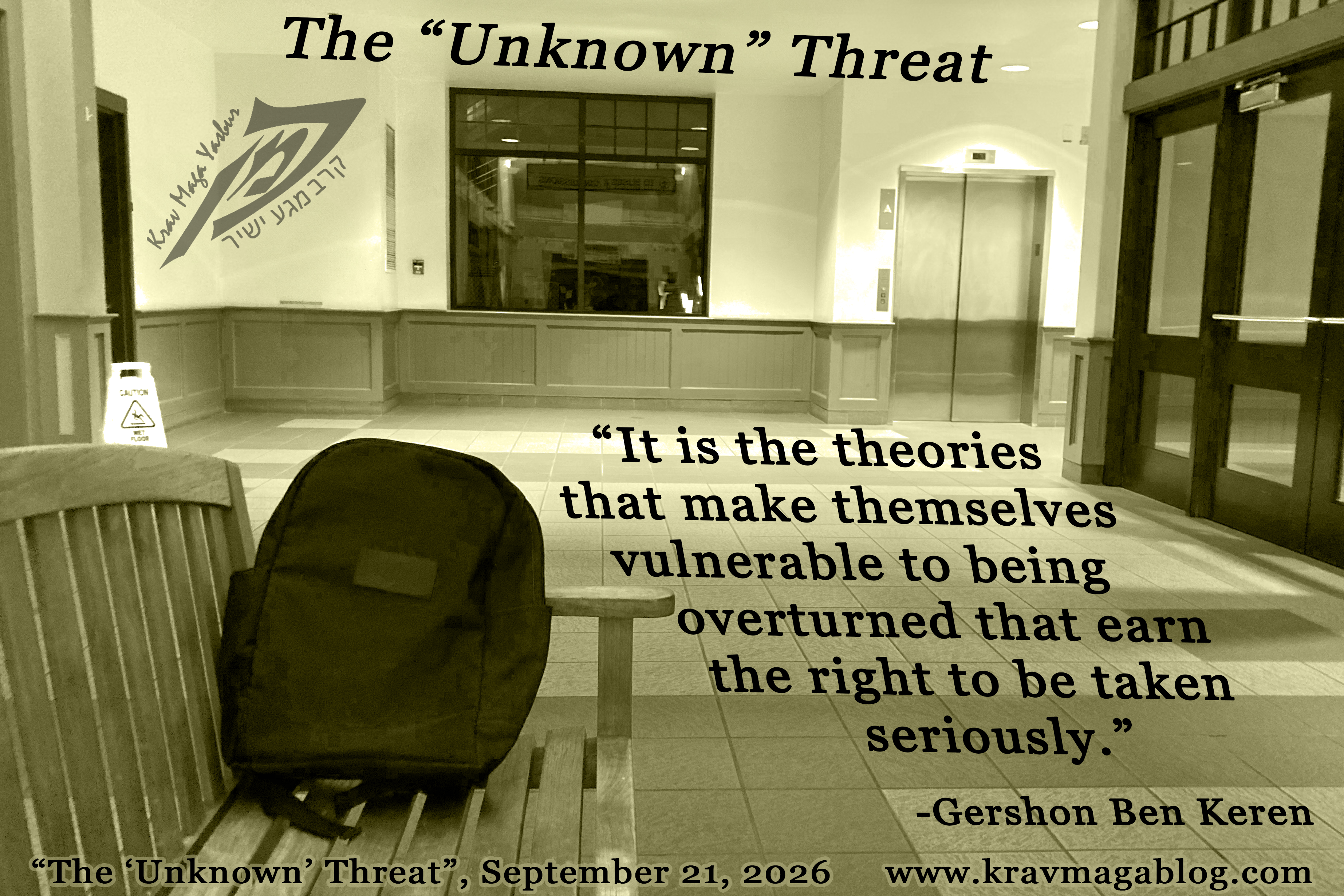
In last week’s article (click here to read). I talked about suspicions and abnormalities, and that things which might appear out of place don’t necessarily indicate a threat and/or the presence of harmful intent etc. In this article I want to look at the relationship between when a suspicion indicates a threat/danger exists, and when it doesn’t. For the sake of this article, it’s worth quickly re-iterating what should cause us to be “suspicious”, whether that’s a person, a place, or an object etc. This means we have to understand the process and/or components concerning that which we’re examining e.g., an unattended bag, in a public space, may initially draw our attention, however if has been left open and we can see that it’s empty, we don’t need to worry about it being a bomb etc. because it doesn’t have the “components” to be a bomb; it’s lacking explosives, a detonator, a power source etc. It’s not an unattended bag itself that should make us suspicious, it’s when we can’t see inside that we become so i.e., when we can’t confirm what it isn’t. Some threats are obvious and overt, but when we can’t refute a suspicion due to the absence of information that should also be treated as a threat.
When I first started my training in security, and was introduced to what was then termed a “dynamic risk assessment”, which was really a “threat” rather than “risk” assessment (over time as you start to develop a consistent and coherent self-protection approach, you often end up keeping the ideas but changing the terms so that the language you use to explain things makes sense), I was taught that the two outcomes from such an assessment was that a person, situation or object was either “high risk” or an “unknown risk”; I would now substitute risk for threat. The idea was there was no such thing as a low risk/threat, as this may cause someone to mentally and physically “stand down”, making them vulnerable. Every threat until confirmed otherwise is either a definite/confirmed threat that needs attention, monitoring and in some cases a response, or an “unknown threat”, which I would now refer to as a “suspicion” i.e., something that needs further investigation, and warrants further investigation until what it is can be refuted and declared benign.
The obvious threat is explicit, i.e., if someone has a knife to our throat, we don’t need to speculate as to their intention. It is obvious that they’re not displaying their weapon in order for us to give it a five-star review etc., however these are the “easy” threats to detect; the “hard” ones are when we have a suspicion (an unknown threat), which we can’t easily identify and classify. This is where we can learn something from the academic method of scientific enquiry. One of the most depressing things for me at this time, is the number of people who believe that their approach to a question or a subject etc., is scientific, or research-based when it is patently not. What people don’t know, they don’t know, and if you haven’t been educated in scientific process (which isn’t your fault), then you probably shouldn’t be claiming that you understand it; this isn’t educational arrogance, it’s just recognizing that you haven’t been trained in something and that your own/personal logic, doesn’t mean that you have. If we want to understand a scientific/research-based approach to anything, including violence and security/personal-safety etc., we need to look at the foundations and principles of Karl Popper.
Karl Popper's philosophy of scientific enquiry rests on a deceptively simple proposition, which is, that knowledge advances not by accumulating proof but by surviving disproof i.e., a threat is detected not by it being a “threat” but by the evidence that it can’t be anything but a threat; there are no alternative explanations for its existence. A hypothesis that cannot be tested against evidence that might refute it, is not a scientific claim at all, instead it is an article of faith dressed in the language of inquiry. What Popper called falsifiability, i.e., the capacity of a proposition to be shown that is wrong, is not a weakness in a theory but the very condition of its intellectual credibility. A claim that nothing could ever disprove something is a claim that tells us nothing useful about the world or adds to a truth. It is the theories that make themselves vulnerable to being overturned that earn the right to be taken seriously. This is one of the reasons why I’m highly suspicious of any “absolute” claims of what certain types of violence are, and especially when an absence of data/information/claims is used to substantiate something i.e., the reason there isn’t data is because there is a cover up etc. This is how “folk devils” are created and “moral panics” occur i.e., people equate the lack of data/information with a cover-up, not because there actually is a lack of data/information. Popper’s methodology helps us navigate such spurious arguments and helps give us a direction concerning personal safety i.e., the absence of a credible threat, doesn’t mean we shouldn’t deem a threat credible, it might mean it’s one we don’t recognize and understand yet.
There is a huge danger in filling in the gaps with our personal beliefs/history, or a social/political position based on our social understanding of ourselves rather than being objective about what is actually happening in our societies. An objective threat is explicit and obvious and requires much more effort in response than enquiry. It is the concealed/hidden threat that is difficult to identify and discern, and that creates the bigger problem. This is where looking to disprove something rather than looking to prove it becomes a much more useful approach concerning personal safety and self-protection.