Author: Gershon Ben Keren
In my final year at university, I took a module/course entitled “Psychology and Radical Economics”. It wasn’t so much by choice but as the result of a scheduling issue – to fit in the subject areas I wanted to study, I was left with a “gap”, that could only be filled by taking this course/module. It was a subject area that I felt completely out of my depth with, and a course that I barely felt I kept a grasp of, however there were only six of us taking the program, and we all bonded over our failings and inadequacies, and kind of supported each other in trying to make sense of the syllabus. We were fortunate in that we had a lecturer/professor who gave us the chance/opportunity to “fail”. Towards the end of the term, we were given the “project” of performing a lecture to the group/class on a particular radical economist, from a psychological perspective. I was allotted the economist Guner Myrdal, not to be confused with the adventurer Thor Heyerdahl (which AI engines sometimes mix up), who led an expedition from South America across the Pacific to the Polynesian Islands on a raft; the Kon-Tiki. Fortunately, back in the day when I was an undergraduate there weren’t search engines and AI that could get confused between these two individuals, and it was a matter of searching for Micro-Fiche articles and books etc., manually – whilst I consider myself a master of this tool, I’m glad that searching and finding articles is so much easier now.
Guner Myrdal is famous – he won a Nobel Prize – for his theory of cumulative causation. An economic theory that he used to explain social phenomena such as racism. As a side note, when I presented my “lecture” on his theory as a student I got invited into the “lecturers lounge” by a newly appointed lecturer, who was waiting outside the room in which I gave my presentation; he thought that because I was the one standing at the front of the class, I must’ve been employed by the university – embarrassed and not knowing how to act or what to say, I accepted his offer of coffee and for 45 minutes saw what went on behind the other side of “the veil” – people are people and the distinction between “professors” and “students” in academia isn’t that great a divide; something I’ve since had confirmed; everyone is fighting for validation. In this article I want to step back over 30-years and review how Gunner Myrdal’s theory of cumulative causation can help us better understand certain types of violence. I believe there is “value” – as well as potential dangers – when disciplines can intersect, and an idea from one, can be transferred, translated, and adopted by another; this unfortunately is somewhat rare in academia, as knowledge is often siloed, rather than “shared” etc. However, when an economist crosses over into sociology/psychology they can present a “new” perspective. Myrdal did this regarding the issue of race in the US. He also believed that because he wasn’t American, he was Swedish, that his position of an “outsider” gave him a different perspective as a commentator on this issue.
Without going into an explanation of cumulative causation as an economic phenomenon – as I will quickly get out of my depth – I’ll attempt to explain it as a social one, initially using it as an explanation and “solution” to racism, as Myrdal did in two books/volumes that he wrote in 1944, entitled, “An American Dilemma”. Myrdal accepted that stereotypes were born out of something, and that something was responsible for that “something” e.g., at the time of his writing (and unfortunately still today) there was a belief by some in the US, that African Americans were of a lower intelligence than White Americans. Whilst there is obviously no genetic or other truth to this belief, there had to be a “reason” why certain individuals believed this. Myrdal’s explanation was that because certain levels of education were restricted, for various reasons, for African Americans then they might as a demographic be relatively uneducated, and that this was perceived to be the result not of a “restriction” to education but that of racial intelligence etc. Myrdal’s solution to this perception was to remove the barriers to education that African Americans were experiencing and to raise – as a group – their educational levels/achievements and that this would address the racial stereotype, and by addressing this stereotype it would have a cumulative effect in addressing other stereotypes and misconceptions etc. He was attempting to use a theory that explained how “confidence” in economic marketplaces, had cumulative effects, which also applied to social perceptions.
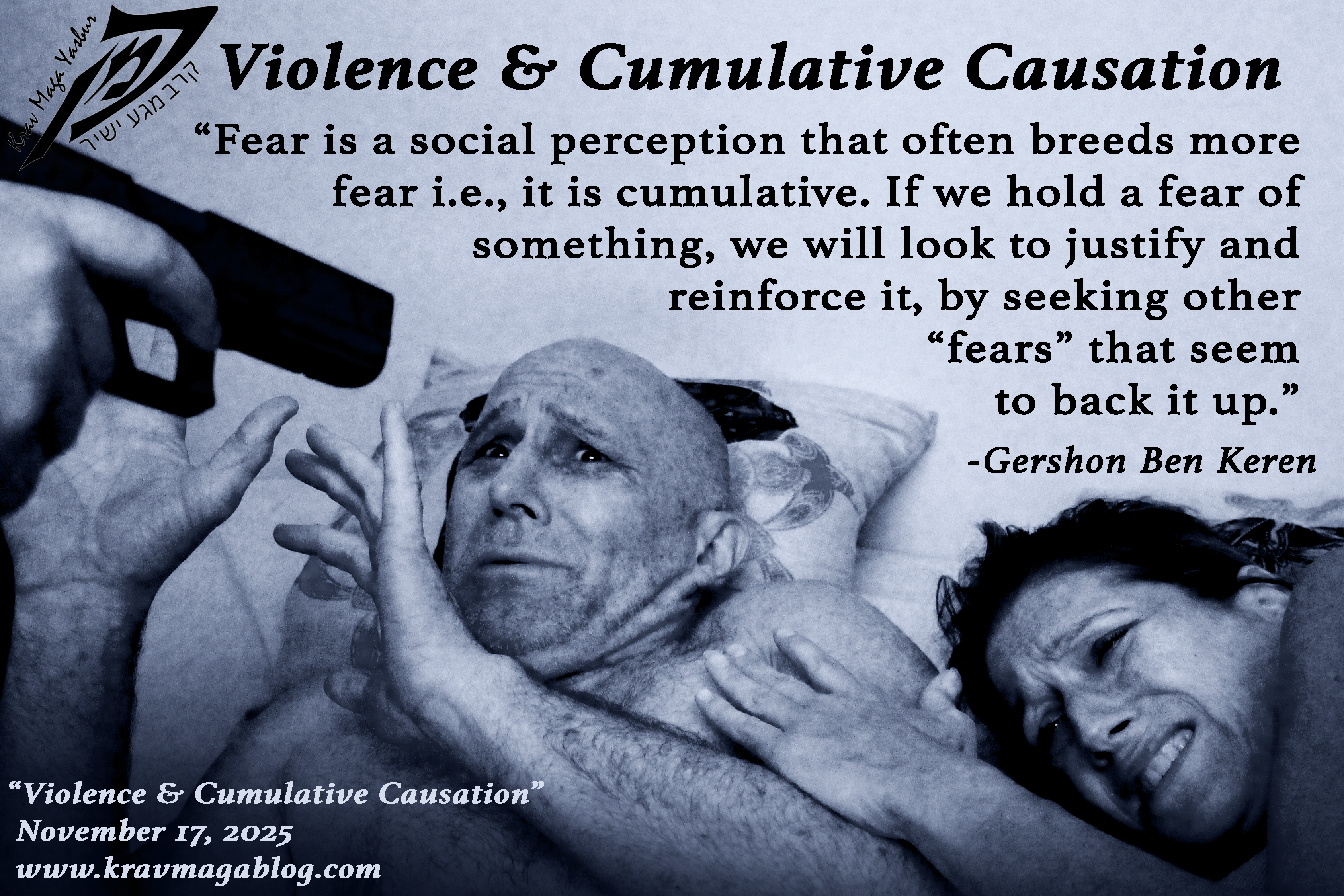
Fear is a social perception that often breeds more fear i.e., it is cumulative. If we hold a fear of something, we will look to justify and reinforce it, by seeking other “fears” that seem to back it up. This is how moral panics, and “folk devils” are created e.g., if immigrants (I write this as an immigrant) are eating cats and dogs, they must be uncivilized, and if they’re uncivilized they must be unintelligent, and if they are unintelligent, they must be criminals, and if they’re criminals they must be violent etc. Myrdal’s idea/theory was to address one thing in this chain to effect all things. There is nothing worse than having unfounded fears; they cause us to worry unnecessarily, and they cause us to lose focus on the real and actual threats. I have spent my life – in various capacities – working on risk management and mitigation, and I have seen and experienced, “cumulative causation’ in action e.g., I have seen rises is the unwarranted fear of those with mental illnesses, such as schizophrenia being linked to violence, and then other things being linked to schizophrenia etc., until everyone who has schizophrenia is seen as a ticking time bomb etc. Whilst we may not be in a position to influence public policy and address societal problems and issues we should recognize how we reinforce our own fears/perceptions in a cumulative manner, and that this can move us away from effective risk/threat analysis and create vulnerabilities. In doing so we should recognize by evaluating one misperceived “fear” in the chain we can address them all.